Supernova
A supernova is the explosive death of a star, during which it rapidly ejects most of its mass in a brilliant burst of light. In core‑collapse supernovae (Types Ib, Ic, II), massive stars (≥ 8 solar masses) exhaust their nuclear fuel, collapse under gravity, and explode. In Type Ia supernovae, a white dwarf in a binary system undergoes runaway fusion after accreting mass. These events deliver heavy elements into space, leave behind neutron stars or black holes, and power typical shock‑front supernova remnants.
Source: heasarc.gsfc.nasa.gov
APODs including "Supernova"
M65 and M66
15/06/2012
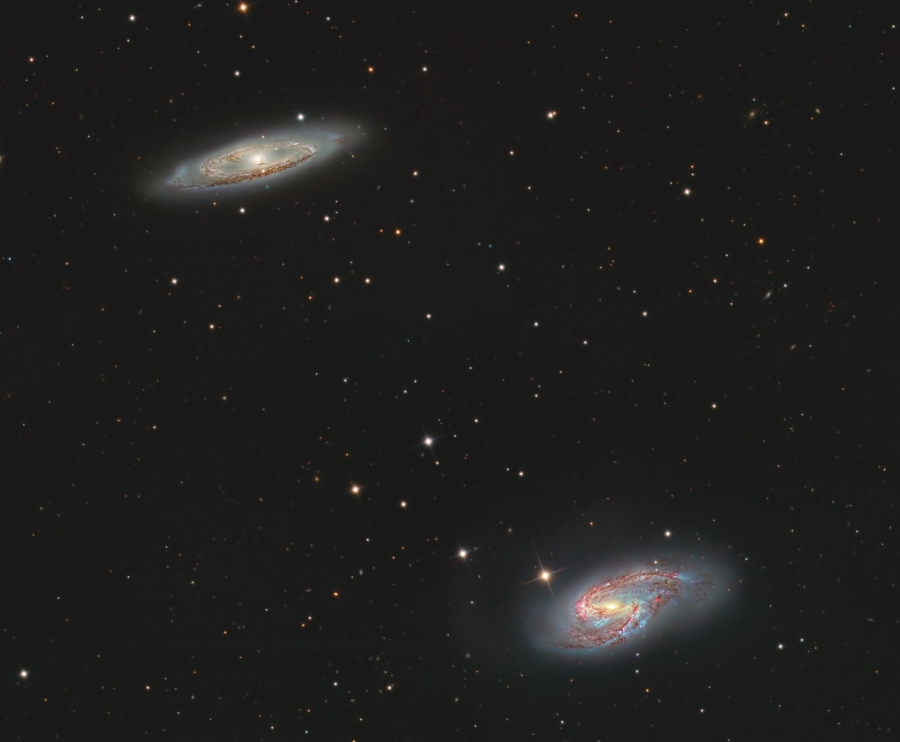
Nearby and bright, spiral galaxies M65 (top) and M66 stand out in this engaging cosmic snapshot. The pair are just 35 million light-years distant and around 100,000 light-years across, about the size of our own spiral Milky Way. While both exhibit prominent dust lanes sweeping along their broad spiral arms, M66 in particular is a striking contrast in red and blue hues; the telltale pinkish glow of hydrogen gas in star forming regions and young blue star clusters. M65 and M66 make up two thirds of the well-known Leo Triplet of galaxies with warps and tidal tails that offer evidence of the group's past close encounters. The larger M66 has been host to four supernovae discovered since 1973.