Supernova
A supernova is the explosive death of a star, during which it rapidly ejects most of its mass in a brilliant burst of light. In core‑collapse supernovae (Types Ib, Ic, II), massive stars (≥ 8 solar masses) exhaust their nuclear fuel, collapse under gravity, and explode. In Type Ia supernovae, a white dwarf in a binary system undergoes runaway fusion after accreting mass. These events deliver heavy elements into space, leave behind neutron stars or black holes, and power typical shock‑front supernova remnants.
Source: heasarc.gsfc.nasa.gov
APODs including "Supernova"
NGC 6188 and NGC 6164
28/12/2012
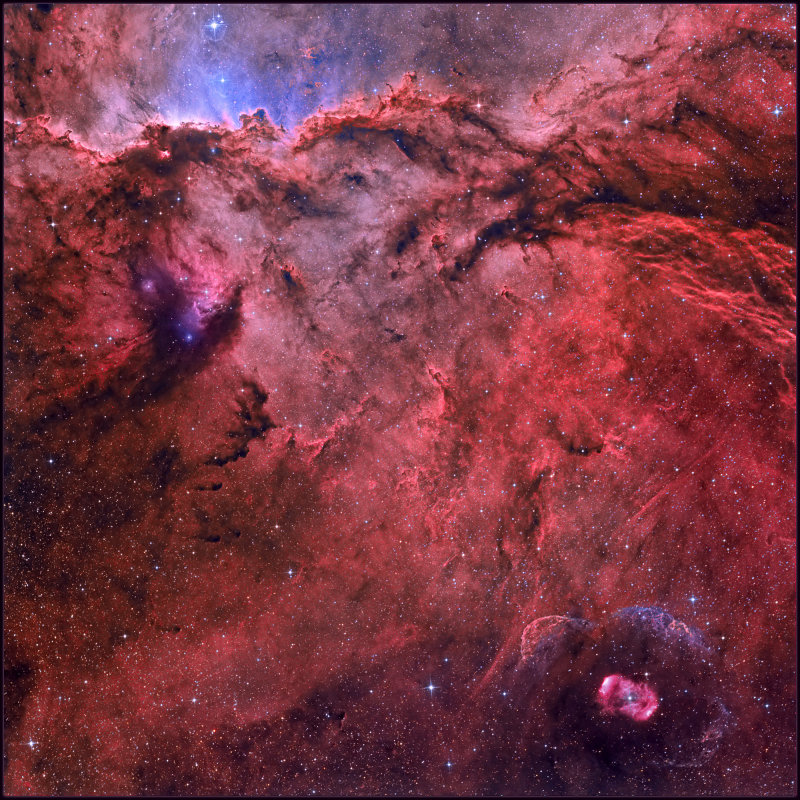
Fantastic shapes lurk in clouds of glowing hydrogen gas in NGC 6188, about 4,000 light-years away. The emission nebula is found near the edge of a large molecular cloud unseen at visible wavelengths, in the southern constellation Ara. Massive, young stars of the embedded Ara OB1 association were formed in that region only a few million years ago, sculpting the dark shapes and powering the nebular glow with stellar winds and intense ultraviolet radiation. The recent star formation itself was likely triggered by winds and supernova explosions, from previous generations of massive stars, that swept up and compressed the molecular gas. Joining NGC 6188 on this cosmic canvas is rare emission nebula NGC 6164, also created by one of the region's massive O-type stars. Similar in appearance to many planetary nebulae, NGC 6164's striking, symmetric gaseous shroud and faint halo surround its bright central star at the lower right. The field of view spans about two full Moons, corresponding to 70 light years at the estimated distance of NGC 6188. Best of APOD 2012: Download a free 2013 APOD Calendar Follow APOD on: Facebook (Daily) (Sky) (Spanish) or Google Plus (Daily) (River)