Supernova
A supernova is the explosive death of a star, during which it rapidly ejects most of its mass in a brilliant burst of light. In core‑collapse supernovae (Types Ib, Ic, II), massive stars (≥ 8 solar masses) exhaust their nuclear fuel, collapse under gravity, and explode. In Type Ia supernovae, a white dwarf in a binary system undergoes runaway fusion after accreting mass. These events deliver heavy elements into space, leave behind neutron stars or black holes, and power typical shock‑front supernova remnants.
Source: heasarc.gsfc.nasa.gov
APODs including "Supernova"
Cas A: Optical and X-ray
17/01/2013
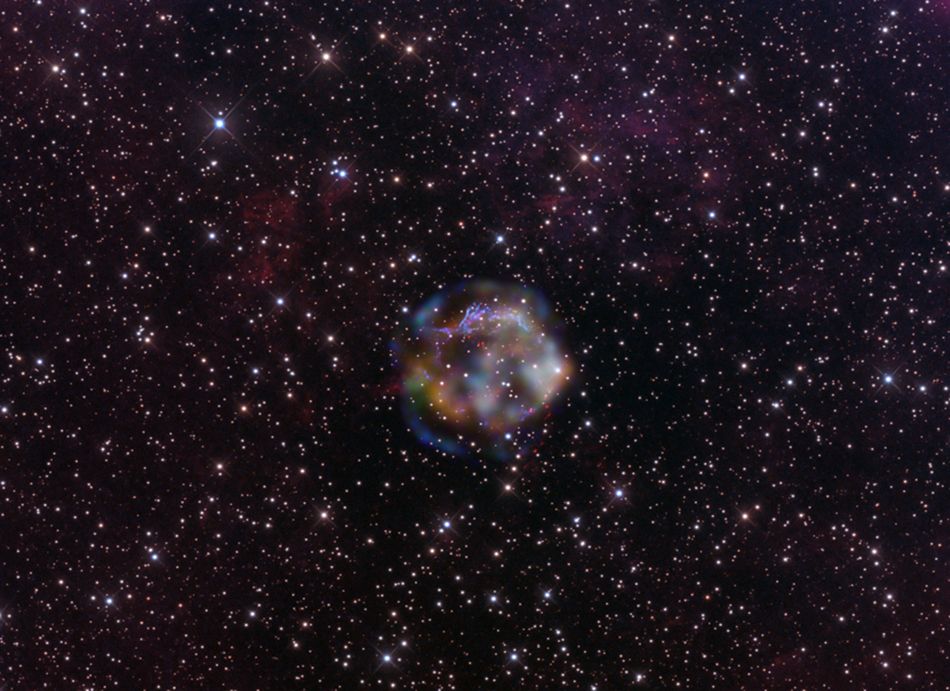
The aftermath of a cosmic cataclysm, supernova remnant Cassiopeia A (Cas A) is a comfortable 11,000 light-years away. Light from the Cas A supernova, the death explosion of a massive star, first reached Earth just 330 years ago. Still expanding, the explosion's debris cloud spans about 15 light-years near the center of this composite image. The scene combines color data of the starry field and fainter filaments of material at optical energies with image data from the orbiting NuSTAR X-ray telescope. Mapped to false colors, the X-ray data in blue hues trace the fragmented outer boundary of the expanding shock wave, glowing at energies up to 10,000 times the energy of the optical photons.