Supernova
A supernova is the explosive death of a star, during which it rapidly ejects most of its mass in a brilliant burst of light. In core‑collapse supernovae (Types Ib, Ic, II), massive stars (≥ 8 solar masses) exhaust their nuclear fuel, collapse under gravity, and explode. In Type Ia supernovae, a white dwarf in a binary system undergoes runaway fusion after accreting mass. These events deliver heavy elements into space, leave behind neutron stars or black holes, and power typical shock‑front supernova remnants.
Source: heasarc.gsfc.nasa.gov
APODs including "Supernova"
Cooling Neutron Star
01/05/2017
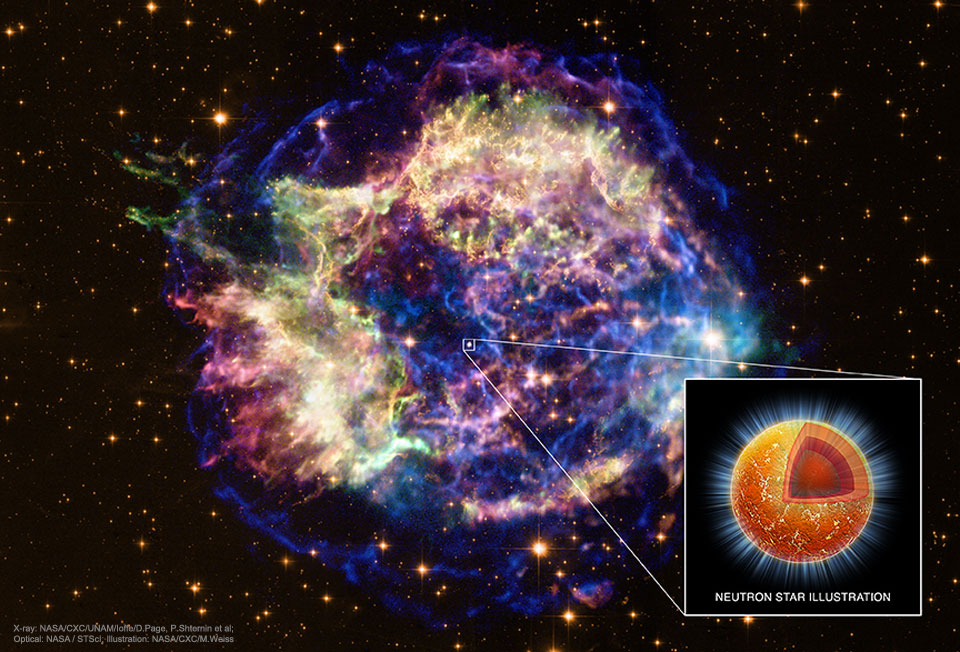
The bright source near the center is a neutron star, the incredibly dense, collapsed remains of a massive stellar core. Surrounding it is supernova remnant Cassiopeia A (Cas A), a comfortable 11,000 light-years away. Light from the Cas A supernova, the death explosion of a massive star, first reached Earth about 350 years ago. The expanding debris cloud spans about 15 light-years in this composite X-ray/optical image. Still hot enough to emit X-rays, Cas A's neutron star is cooling. In fact, years of observations with the orbiting Chandra X-ray Observatory find that the neutron star is cooling rapidly -- so rapidly that researchers suspect a large part of the neutron star's core is forming a frictionless neutron superfluid. The Chandra results represent the first observational evidence for this bizarre state of neutron matter.