Supernova
A supernova is the explosive death of a star, during which it rapidly ejects most of its mass in a brilliant burst of light. In core‑collapse supernovae (Types Ib, Ic, II), massive stars (≥ 8 solar masses) exhaust their nuclear fuel, collapse under gravity, and explode. In Type Ia supernovae, a white dwarf in a binary system undergoes runaway fusion after accreting mass. These events deliver heavy elements into space, leave behind neutron stars or black holes, and power typical shock‑front supernova remnants.
Source: heasarc.gsfc.nasa.gov
APODs including "Supernova"
Thor's Helmet Emission Nebula
01/11/2017
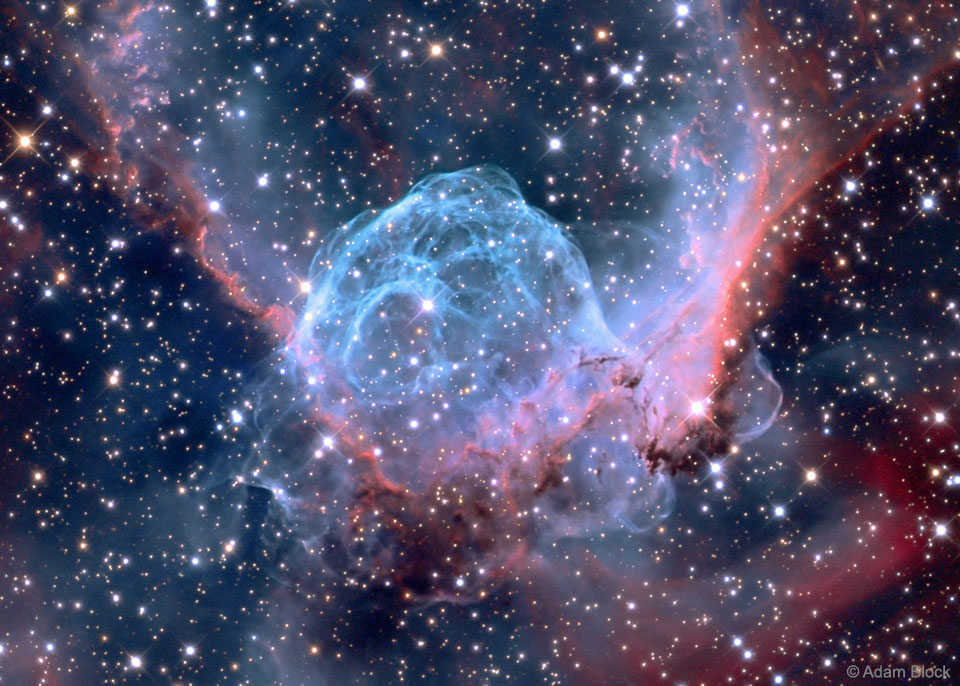
This helmet-shaped cosmic cloud with wing-like appendages is popularly called Thor's Helmet. Heroically sized even for a Norse god, Thor's Helmet spans about 30 light-years across. In fact, the helmet is more like an interstellar bubble, blown as a fast wind -- from the bright star near the center of the bubble's blue-hued region -- sweeps through a surrounding molecular cloud. This star, a Wolf-Rayet star, is a massive and extremely hot giant star thought to be in a brief, pre-supernova stage of evolution. Cataloged as NGC 2359, the emission nebula is located about 12,000 light-years away toward the constellation of the Big Dog (Canis Major). The sharp image, made using broadband and narrowband filters, captures striking details of the nebula's filamentary gas and dust structures. The blue color originates from strong emission from oxygen atoms in the nebula. Follow APOD on: Facebook, Google Plus, Instagram, or Twitter