Supernova
A supernova is the explosive death of a star, during which it rapidly ejects most of its mass in a brilliant burst of light. In core‑collapse supernovae (Types Ib, Ic, II), massive stars (≥ 8 solar masses) exhaust their nuclear fuel, collapse under gravity, and explode. In Type Ia supernovae, a white dwarf in a binary system undergoes runaway fusion after accreting mass. These events deliver heavy elements into space, leave behind neutron stars or black holes, and power typical shock‑front supernova remnants.
Source: heasarc.gsfc.nasa.gov
APODs including "Supernova"
The Gum Nebula Expanse
24/05/2018
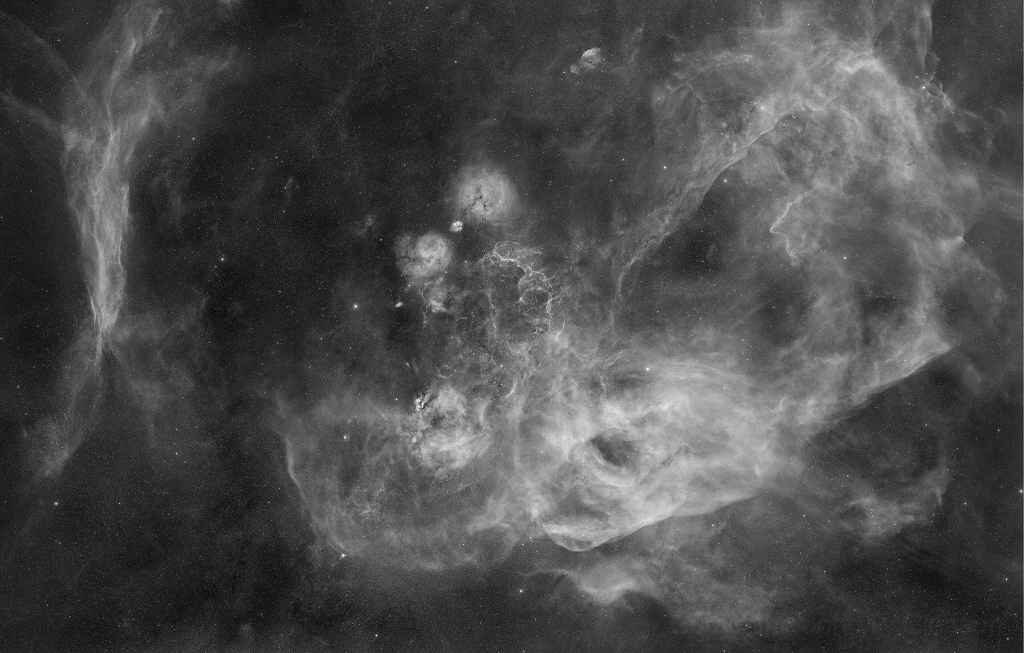
Named for a cosmic cloud hunter, Australian astronomer Colin Stanley Gum (1924-1960), The Gum Nebula is so large and close it is actually hard to see. In fact, we are only about 450 light-years from the front edge and 1,500 light-years from the back edge of this interstellar expanse of glowing hydrogen gas. Covered in this 40+ degree-wide monochrome mosaic of Hydrogen-alpha images, the faint emission region stands out against the background of Milky Way stars. The complex nebula is thought to be a supernova remnant over a million years old, sprawling across the Ship's southern constellations Vela and Puppis. This spectacular wide field view also explores many objects embedded in The Gum Nebula, including the younger Vela supernova remnant.