Supernova
A supernova is the explosive death of a star, during which it rapidly ejects most of its mass in a brilliant burst of light. In core‑collapse supernovae (Types Ib, Ic, II), massive stars (≥ 8 solar masses) exhaust their nuclear fuel, collapse under gravity, and explode. In Type Ia supernovae, a white dwarf in a binary system undergoes runaway fusion after accreting mass. These events deliver heavy elements into space, leave behind neutron stars or black holes, and power typical shock‑front supernova remnants.
Source: heasarc.gsfc.nasa.gov
APODs including "Supernova"
A Black Hole Disrupts a Passing Star
24/03/2020
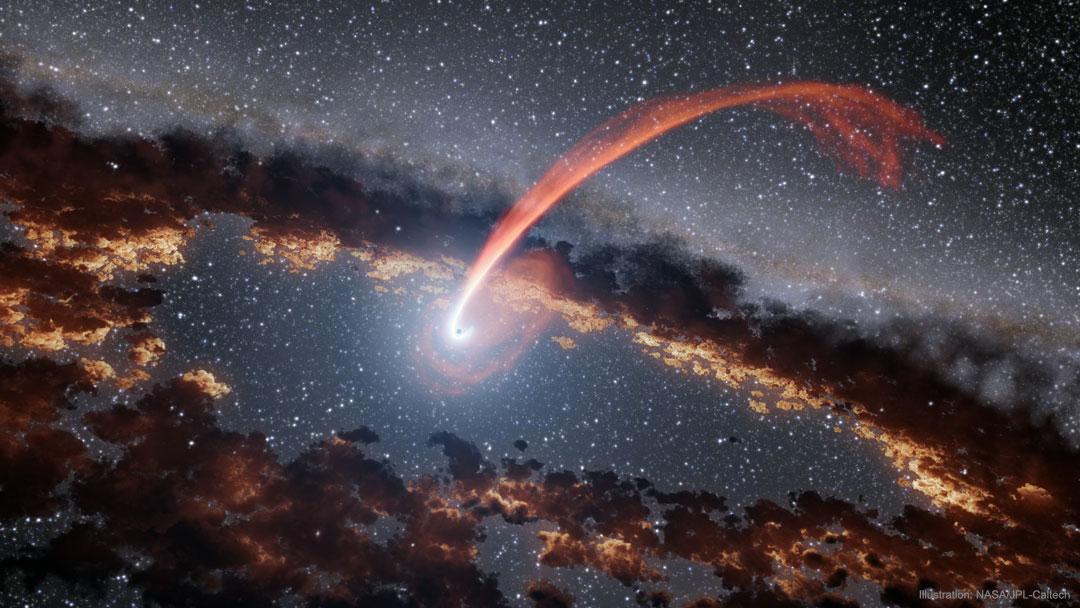
What happens to a star that goes near a black hole? If the star directly impacts a massive black hole, then the star falls in completely -- and everything vanishes. More likely, though, the star goes close enough to have the black hole's gravity pull away the outer layers of the star, or disrupt the star. Then most of the star's gas does not fall into the black hole. These stellar tidal disruption events can be as bright as a supernova, and an increasing amount of them are being discovered by automated sky surveys. In the featured artist's illustration, a star has just passed a massive black hole and sheds gas that continues to orbit. The inner edge of a disk of gas and dust surrounding the black hole is heated by the disruption event and may glow long after the star is gone.