Supernova
A supernova is the explosive death of a star, during which it rapidly ejects most of its mass in a brilliant burst of light. In core‑collapse supernovae (Types Ib, Ic, II), massive stars (≥ 8 solar masses) exhaust their nuclear fuel, collapse under gravity, and explode. In Type Ia supernovae, a white dwarf in a binary system undergoes runaway fusion after accreting mass. These events deliver heavy elements into space, leave behind neutron stars or black holes, and power typical shock‑front supernova remnants.
Source: heasarc.gsfc.nasa.gov
APODs including "Supernova"
M82: Starburst Galaxy with a Superwind
09/07/2021
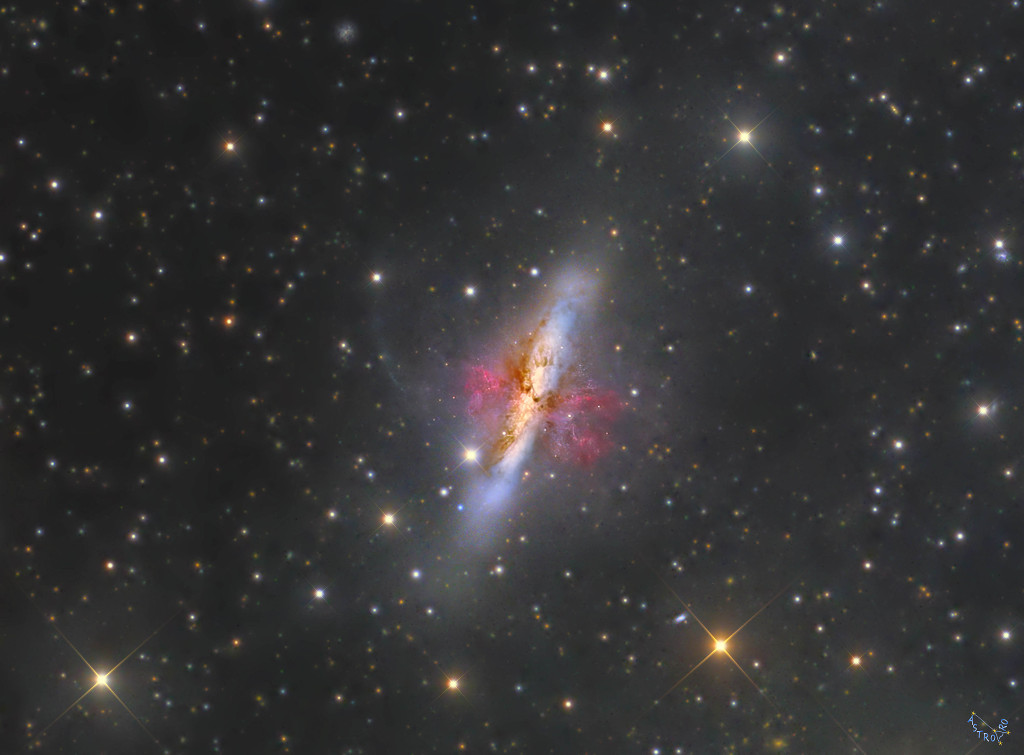
M82 is a starburst galaxy with a superwind. In fact, through ensuing supernova explosions and powerful winds from massive stars, the burst of star formation in M82 is driving a prodigious outflow. Evidence for the superwind from the galaxy's central regions is clear in sharp telescopic snapshot. The composite image highlights emission from long outflow filaments of atomic hydrogen gas in reddish hues. Some of the gas in the superwind, enriched in heavy elements forged in the massive stars, will eventually escape into intergalactic space. Triggered by a close encounter with nearby large galaxy M81, the furious burst of star formation in M82 should last about 100 million years or so. Also known as the Cigar Galaxy for its elongated visual appearance, M82 is about 30,000 light-years across. It lies 12 million light-years away near the northern boundary of Ursa Major.