Supernova
A supernova is the explosive death of a star, during which it rapidly ejects most of its mass in a brilliant burst of light. In core‑collapse supernovae (Types Ib, Ic, II), massive stars (≥ 8 solar masses) exhaust their nuclear fuel, collapse under gravity, and explode. In Type Ia supernovae, a white dwarf in a binary system undergoes runaway fusion after accreting mass. These events deliver heavy elements into space, leave behind neutron stars or black holes, and power typical shock‑front supernova remnants.
Source: heasarc.gsfc.nasa.gov
APODs including "Supernova"
Wolf's Cave Nebula
15/11/2022
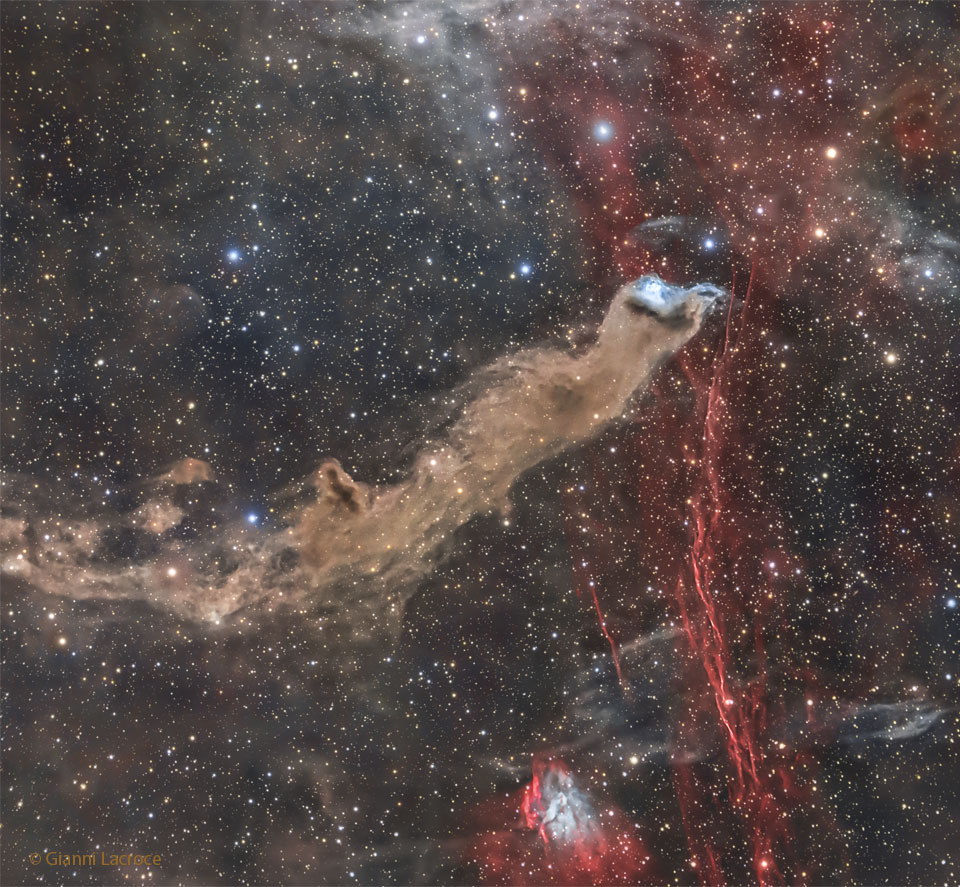
The mysterious blue reflection nebula found in catalogs as VdB 152 or Ced 201 really is very faint. It lies at the tip of the long dark nebula Barnard 175 in a dusty complex that has also been called Wolf's Cave. At the center of this deep telescopic view, the cosmic apparitions are nearly 1,400 light-years away along the northern Milky Way in the royal constellation Cepheus. Interstellar dust in the region blocks light from background stars and scatters light from the embedded bright star, giving the end nebula its characteristic blue color. Though stars do form in molecular clouds, this star seems to have only accidentally wandered into the area, as its measured velocity through space is very different from the cloud's velocity. At the image bottom is the planetary nebula Dengel-Hartl 5, while red glowing gas from an ancient supernova remnant is also visible along the image's right side.