Supernova
A supernova is the explosive death of a star, during which it rapidly ejects most of its mass in a brilliant burst of light. In core‑collapse supernovae (Types Ib, Ic, II), massive stars (≥ 8 solar masses) exhaust their nuclear fuel, collapse under gravity, and explode. In Type Ia supernovae, a white dwarf in a binary system undergoes runaway fusion after accreting mass. These events deliver heavy elements into space, leave behind neutron stars or black holes, and power typical shock‑front supernova remnants.
Source: heasarc.gsfc.nasa.gov
APODs including "Supernova"
Wolf-Rayet 124
18/03/2023
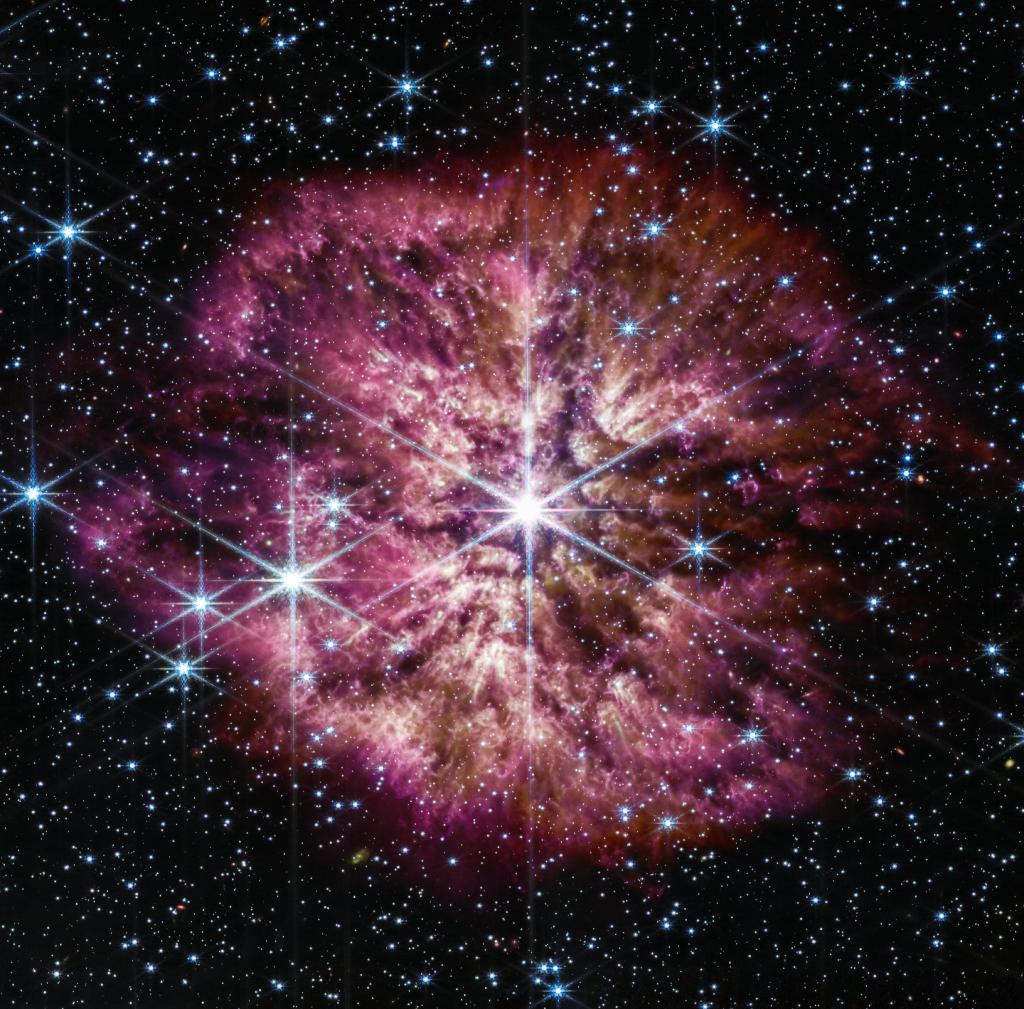
Driven by powerful stellar winds, expanding shrouds of gas and dust frame hot, luminous star Wolf-Rayet 124 in this sharp infrared view. The eye-catching 6-spike star pattern is characteristic of stellar images made with the 18 hexagonal mirrors of the James Webb Space Telescope. About 15,000 light-years distant toward the pointed northern constellation Sagitta, WR 124 has over 30 times the mass of the Sun. Produced in a brief and rarely spotted phase of massive star evolution in the Milky Way, this star's turbulent nebula is nearly 6 light-years across. It heralds WR 124's impending stellar death in a supernova explosion. Formed in the expanding nebula, dusty interstellar debris that survives the supernova will influence the formation of future generations of stars.