Supernova
A supernova is the explosive death of a star, during which it rapidly ejects most of its mass in a brilliant burst of light. In core‑collapse supernovae (Types Ib, Ic, II), massive stars (≥ 8 solar masses) exhaust their nuclear fuel, collapse under gravity, and explode. In Type Ia supernovae, a white dwarf in a binary system undergoes runaway fusion after accreting mass. These events deliver heavy elements into space, leave behind neutron stars or black holes, and power typical shock‑front supernova remnants.
Source: heasarc.gsfc.nasa.gov
APODs including "Supernova"
Rigel Wide
07/04/2023
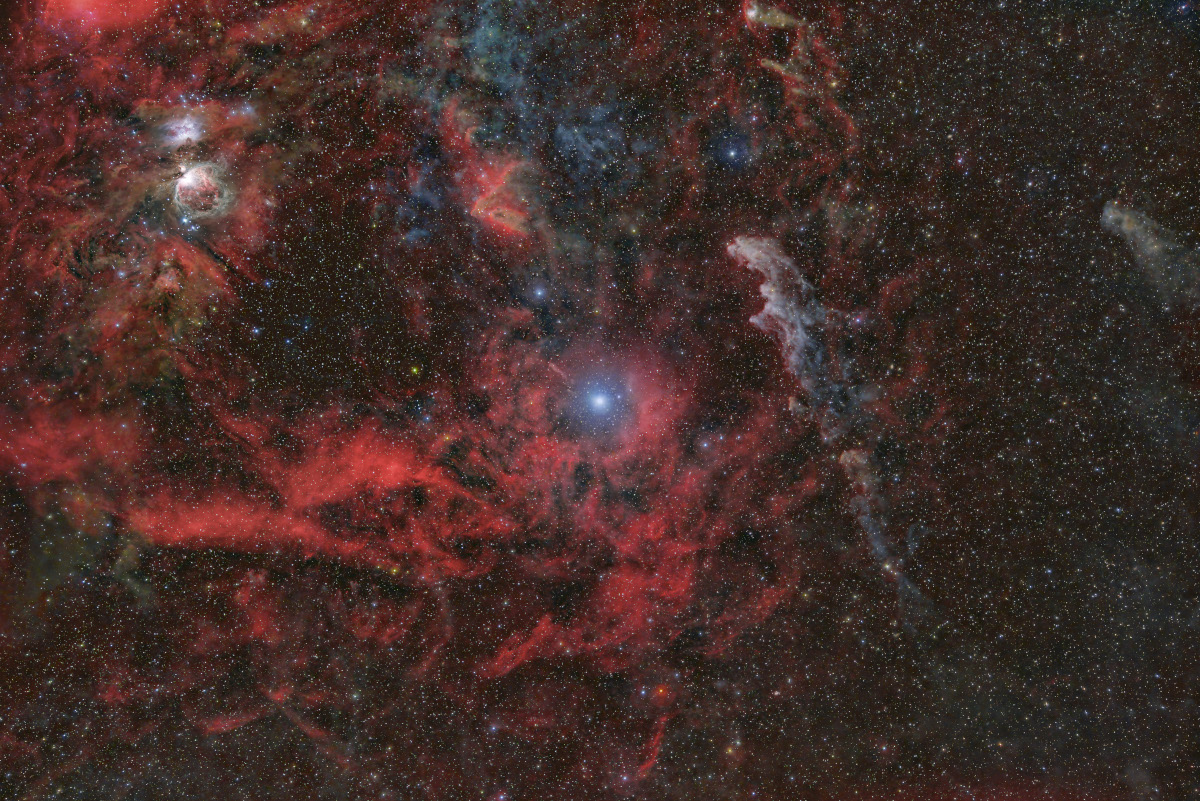
Brilliant, blue, supergiant star Rigel marks the foot of Orion the Hunter in planet Earth's night. Designated Beta Orionis, it's at the center of this remarkably deep and wide field of view. Rigel's blue color indicates that it is much hotter than its rival supergiant in Orion the yellowish Betelgeuse (Alpha Orionis), though both stars are massive enough to eventually end their days as core collapse supernovae. Some 860 light-years away, Rigel is hotter than the Sun too and extends to about 74 times the solar radius. That's about the size of the orbit of Mercury. In the 10 degree wide frame toward the nebula rich constellation, the Orion Nebula is at the upper left. To the right of Rigel and illuminated by its brilliant blue starlight lies the dusty Witch Head Nebula. Rigel is part of a multiple star system, though its companion stars are much fainter.