Supernova
A supernova is the explosive death of a star, during which it rapidly ejects most of its mass in a brilliant burst of light. In core‑collapse supernovae (Types Ib, Ic, II), massive stars (≥ 8 solar masses) exhaust their nuclear fuel, collapse under gravity, and explode. In Type Ia supernovae, a white dwarf in a binary system undergoes runaway fusion after accreting mass. These events deliver heavy elements into space, leave behind neutron stars or black holes, and power typical shock‑front supernova remnants.
Source: heasarc.gsfc.nasa.gov
APODs including "Supernova"
M41: The Little Beehive Star Cluster
25/02/2025
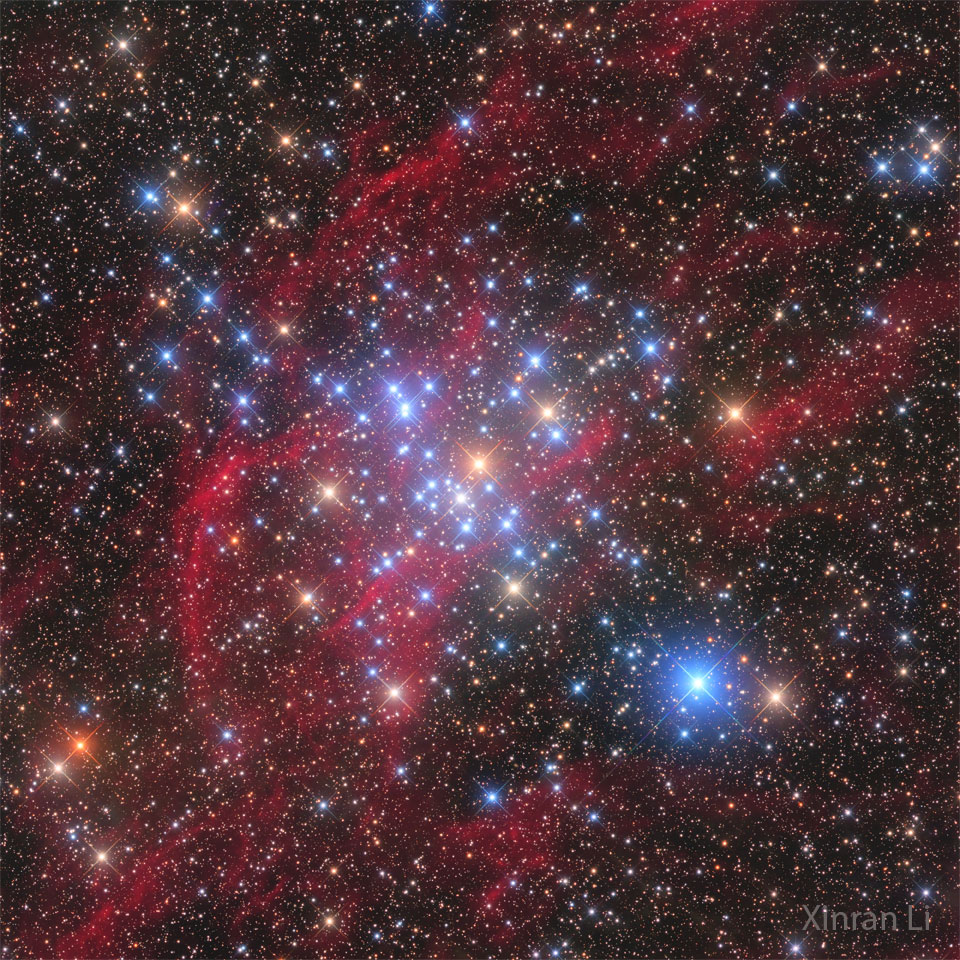
Why are there so many bright blue stars? Stars are usually born in clusters, and the brightest and most massive of these stars typically glow blue. Less-bright, non-blue stars like our Sun surely also exist in this M41 star cluster but are harder to see. A few bright orange-appearing red giant stars are visible. The red-light filaments are emitted by diffuse hydrogen gas, a color that was specifically filtered and enhanced in this image. In a hundred million years or so, the bright blue stars will have exploded in supernovas and disappeared, while the slightly different trajectories of the fainter stars will cause this picturesque open cluster to disperse. Similarly, billions of years ago, our own Sun was likely born into a star cluster like M41, but it has long since drifted apart from its sister stars. The featured image was captured over four hours with Chilescope T2 in Chile.