Supernova
A supernova is the explosive death of a star, during which it rapidly ejects most of its mass in a brilliant burst of light. In core‑collapse supernovae (Types Ib, Ic, II), massive stars (≥ 8 solar masses) exhaust their nuclear fuel, collapse under gravity, and explode. In Type Ia supernovae, a white dwarf in a binary system undergoes runaway fusion after accreting mass. These events deliver heavy elements into space, leave behind neutron stars or black holes, and power typical shock‑front supernova remnants.
Source: heasarc.gsfc.nasa.gov
APODs including "Supernova"
A Milky Road to the Rubin Observatory
04/06/2025
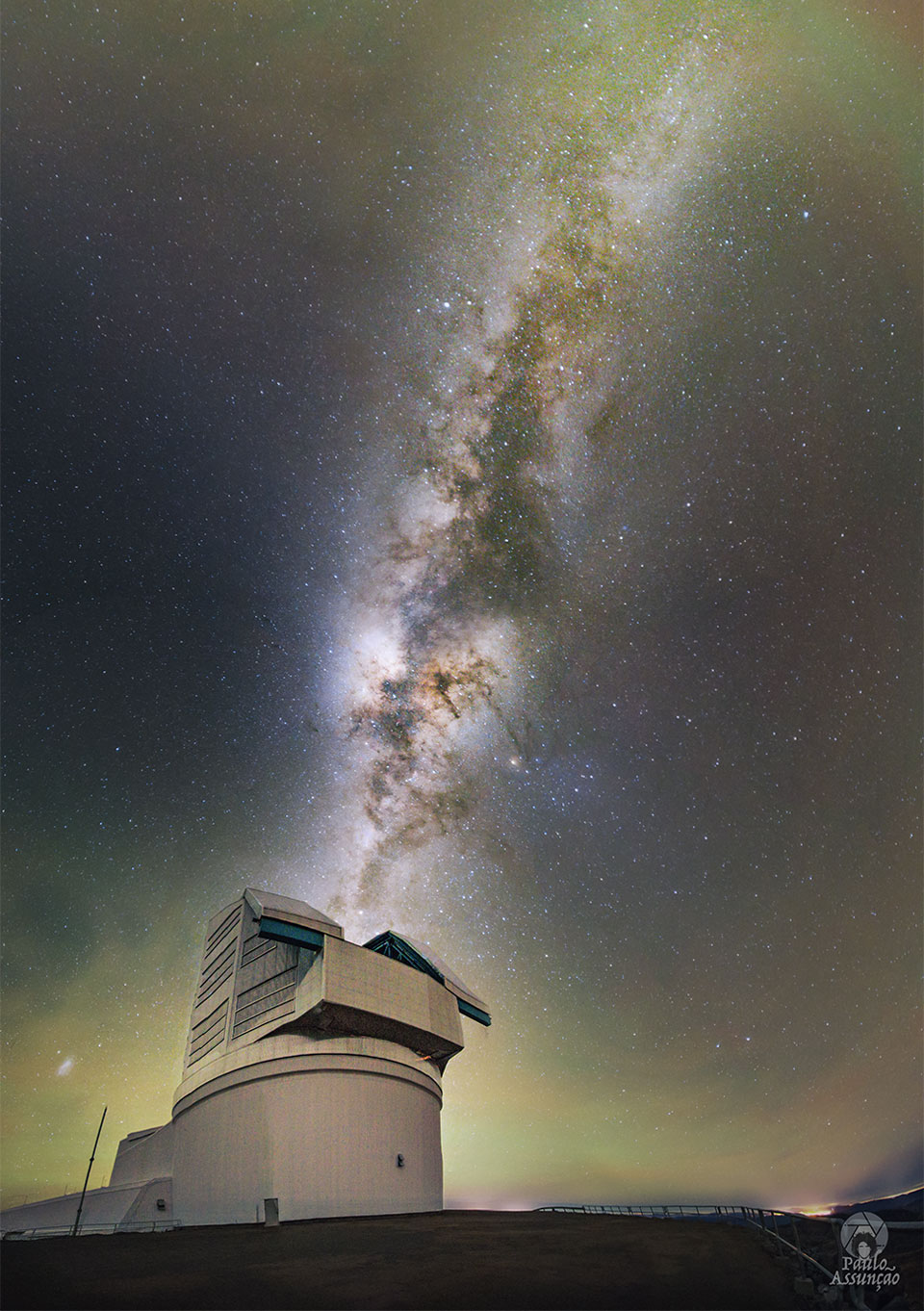
Is the sky the same every night? No -- the night sky changes every night in many ways. To better explore how the night sky changes, the USA's NSF and DOE commissioned the Vera C. Rubin Observatory in Cerro Pachón, Chile. In final testing before routine operations, Rubin will begin to explore these nightly changes -- slight differences that can tell us much about our amazing universe and its surprising zoo of objects. With a mirror over 8 meters across, Rubin will continually reimage the entire visible sky every few nights to discover new supernovas, potentially dangerous asteroids, faint comets, and variable stars -- as well as mapping out the visible universe's large-scale structure. Pictured, the distant central band of our Milky Way Galaxy appears to flow out from the newly operational observatory. Taken last month, the featured picture is a composite of 21 images across the night sky, capturing airglow on the horizon and the Small Magellanic Cloud galaxy on the lower left. APOD Turns 30!: Free Public Lecture in Anchorage on June 11