Supernova
A supernova is the explosive death of a star, during which it rapidly ejects most of its mass in a brilliant burst of light. In core‑collapse supernovae (Types Ib, Ic, II), massive stars (≥ 8 solar masses) exhaust their nuclear fuel, collapse under gravity, and explode. In Type Ia supernovae, a white dwarf in a binary system undergoes runaway fusion after accreting mass. These events deliver heavy elements into space, leave behind neutron stars or black holes, and power typical shock‑front supernova remnants.
Source: heasarc.gsfc.nasa.gov
APODs including "Supernova"
NGC 300: A Cosmic Gemstone with Stars and Gas Clouds
16/07/2026
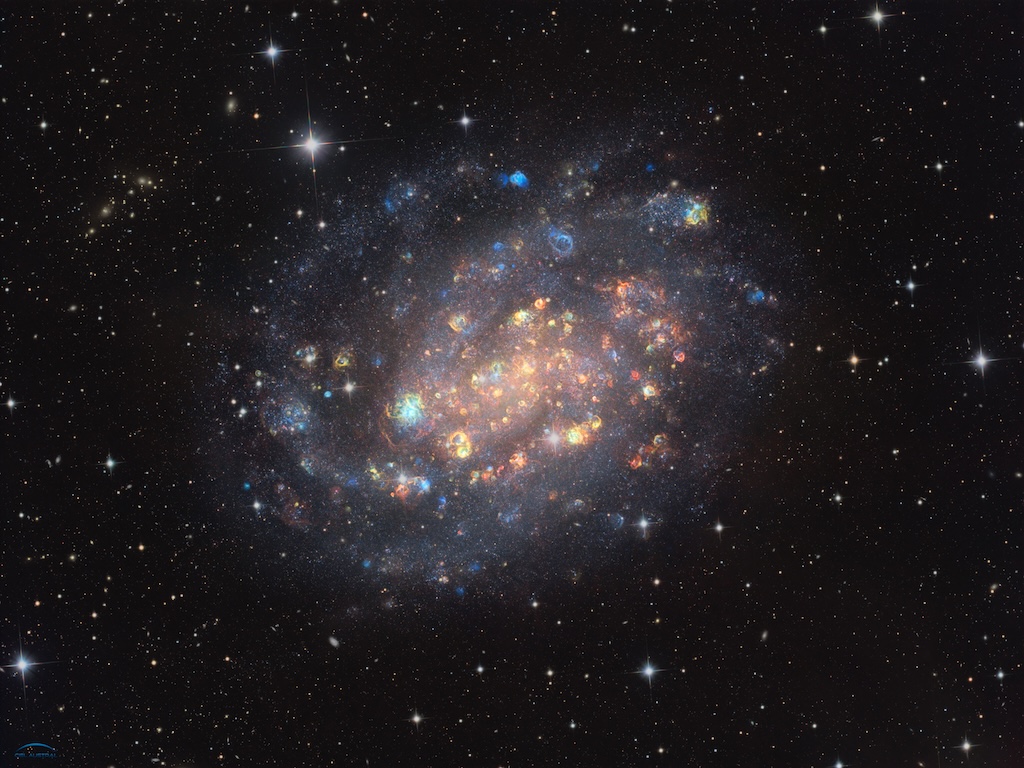
This sparkling, colorful gemstone is a spiral galaxy, NGC 300. It is one of the closest spiral galaxies to Earth, only about 6 million light-years away. But does it really look like this? Here is a more standard portrait of it. This unusual image combines the light from the stars and dust within the galaxy with the light from ionized clouds of interstellar gas shown in red (Sulphur), green (Hydrogen) and blue (Oxygen). Combining red and green light in different proportions makes yellow or orange light, most visible in the image. Light from other ionized gases is also at work in neon signs, fluorescent tubes and street lights. These massive clouds of ionized gas are typically created by young, massive stars that produce high-energy ultraviolet radiation capable of ionizing the gas. Massive stars are short-lived, compared with lighter stars like our sun, and explode as supernovas at the end of their lives. Some of the colorful clouds in the image could be hiding supernova remnants.