Tarantula Nebula
The Tarantula Nebula (also known as NGC 2070 or 30 Doradus) is the largest and most active star-forming region in the Local Group, located in the Large Magellanic Cloud about 160,000–170,000 light‑years away. Spanning roughly 600 light‑years, it hosts massive young star clusters like R136, contains some of the most massive stars known (up to ~200 M☉), and is shaped by intense radiation, stellar winds, and supernovae.
Source: science.nasa.gov
APODs including "Tarantula Nebula"
A Magellanic Mural
03/02/1998
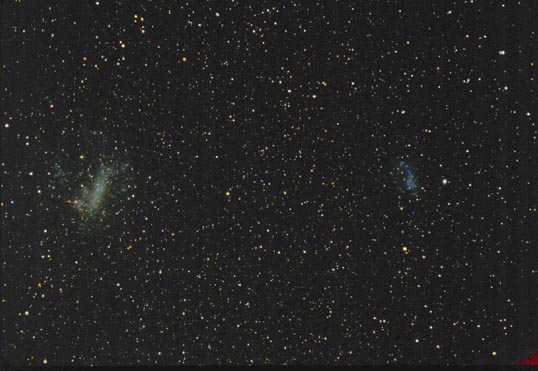
Two galaxies stand out to casual observers in Earth's Southern Hemisphere: the Large Magellanic Cloud (LMC) and the Small Magellanic Cloud (SMC). These irregular galaxies are two of the closest galaxies to our Milky Way Galaxy. Recent observations of the LMC (on the left) have determined that it is on a nearly circular orbit around our Galaxy, and have even helped in the determination of the composition of dark matter in our Galaxy. The above photograph spans 40 degrees. Visible on the lower left of the LMC is the Tarantula Nebula (in red). In the foreground to the right of the SMC is globular cluster 47 Tucanae, appearing here as a bright point of light.