Tarantula Nebula
The Tarantula Nebula (also known as NGC 2070 or 30 Doradus) is the largest and most active star-forming region in the Local Group, located in the Large Magellanic Cloud about 160,000–170,000 light‑years away. Spanning roughly 600 light‑years, it hosts massive young star clusters like R136, contains some of the most massive stars known (up to ~200 M☉), and is shaped by intense radiation, stellar winds, and supernovae.
Source: science.nasa.gov
APODs including "Tarantula Nebula"
NGC 604: Giant Stellar Nursery
11/12/2012
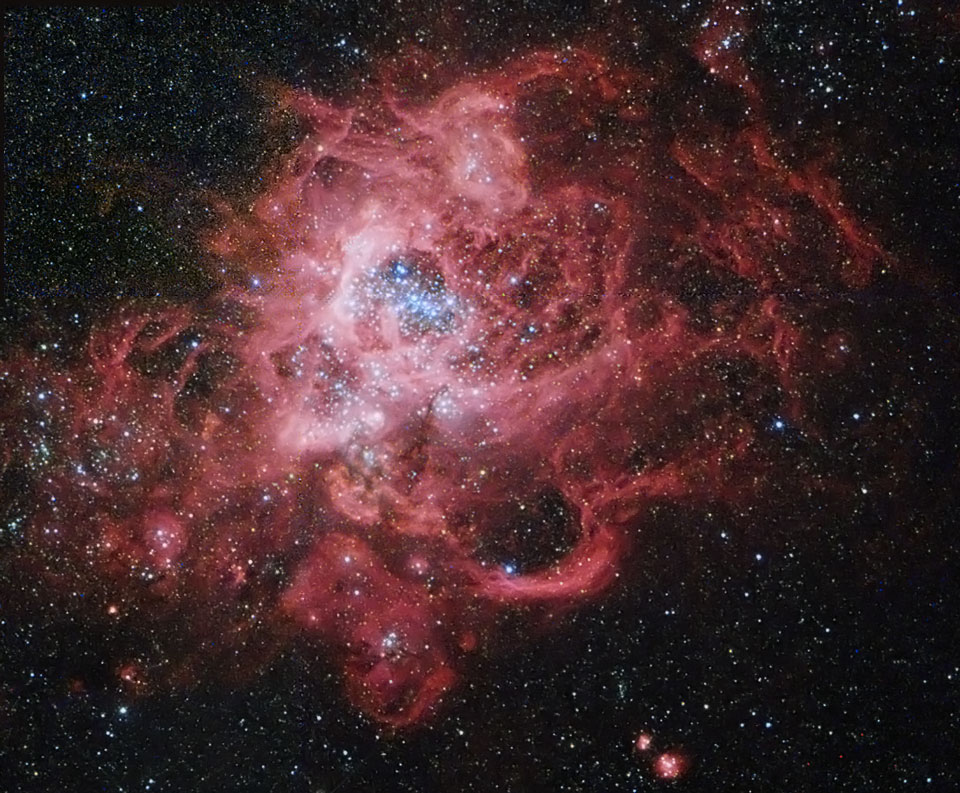
Stars are sometimes born in the midst of chaos. About 3 million years ago in the nearby galaxy M33, a large cloud of gas spawned dense internal knots which gravitationally collapsed to form stars. NGC 604 was so large, however, it could form enough stars to make a globular cluster. Many young stars from this cloud are visible in the above image from the Hubble Space Telescope, along with what is left of the initial gas cloud. Some stars were so massive they have already evolved and exploded in a supernova. The brightest stars that are left emit light so energetic that they create one of the largest clouds of ionized hydrogen gas known, comparable to the Tarantula Nebula in our Milky Way's close neighbor, the Large Magellanic Cloud.