Tarantula Nebula
The Tarantula Nebula (also known as NGC 2070 or 30 Doradus) is the largest and most active star-forming region in the Local Group, located in the Large Magellanic Cloud about 160,000–170,000 light‑years away. Spanning roughly 600 light‑years, it hosts massive young star clusters like R136, contains some of the most massive stars known (up to ~200 M☉), and is shaped by intense radiation, stellar winds, and supernovae.
Source: science.nasa.gov
APODs including "Tarantula Nebula"
Infrared Portrait of the Large Magellanic Cloud
23/03/2013
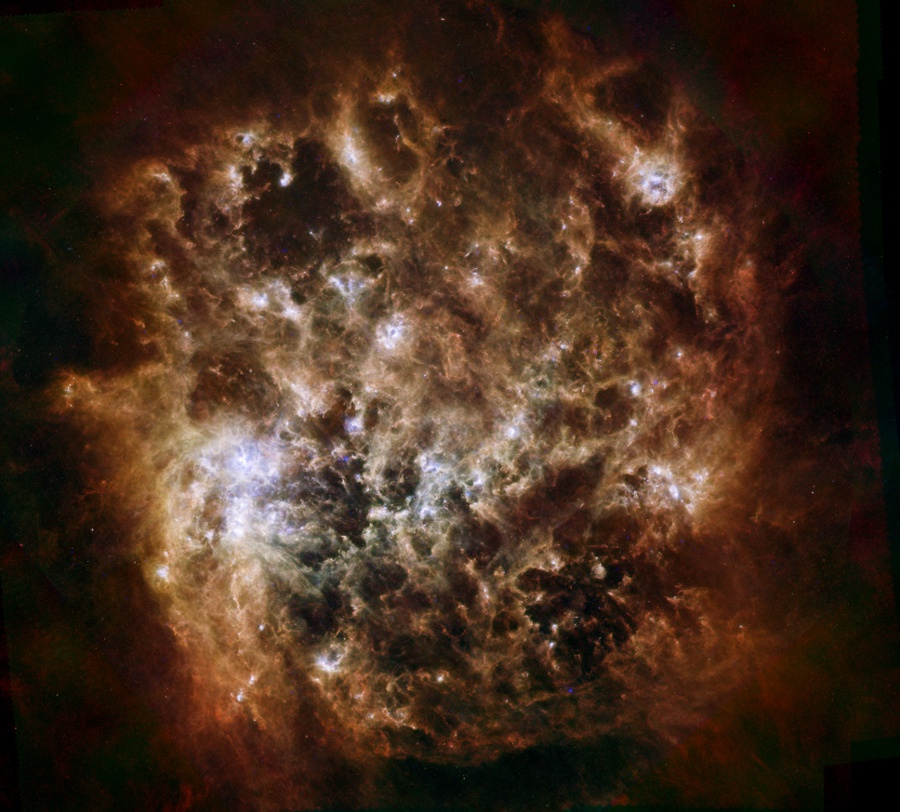
Cosmic dust clouds ripple across this infrared portrait of our Milky Way's satellite galaxy, the Large Magellanic Cloud. In fact, the remarkable composite image from the Herschel Space Observatory and the Spitzer Space Telescope show that dust clouds fill this neighboring dwarf galaxy, much like dust along the plane of the Milky Way itself. The dust temperatures tend to trace star forming activity. Spitzer data in blue hues indicate warm dust heated by young stars. Herschel's instruments contributed the image data shown in red and green, revealing dust emission from cooler and intermediate regions where star formation is just beginning or has stopped. Dominated by dust emission, the Large Magellanic Cloud's infrared appearance is different from views in optical images. But this galaxy's well-known Tarantula Nebula still stands out, easily seen here as the brightest region to the left of center. A mere 160,000 light-years distant, the Large Cloud of Magellan is about 30,000 light-years across.