Tarantula Nebula
The Tarantula Nebula (also known as NGC 2070 or 30 Doradus) is the largest and most active star-forming region in the Local Group, located in the Large Magellanic Cloud about 160,000–170,000 light‑years away. Spanning roughly 600 light‑years, it hosts massive young star clusters like R136, contains some of the most massive stars known (up to ~200 M☉), and is shaped by intense radiation, stellar winds, and supernovae.
Source: science.nasa.gov
APODs including "Tarantula Nebula"
The Seahorse of the Large Magellanic Cloud
30/11/2014
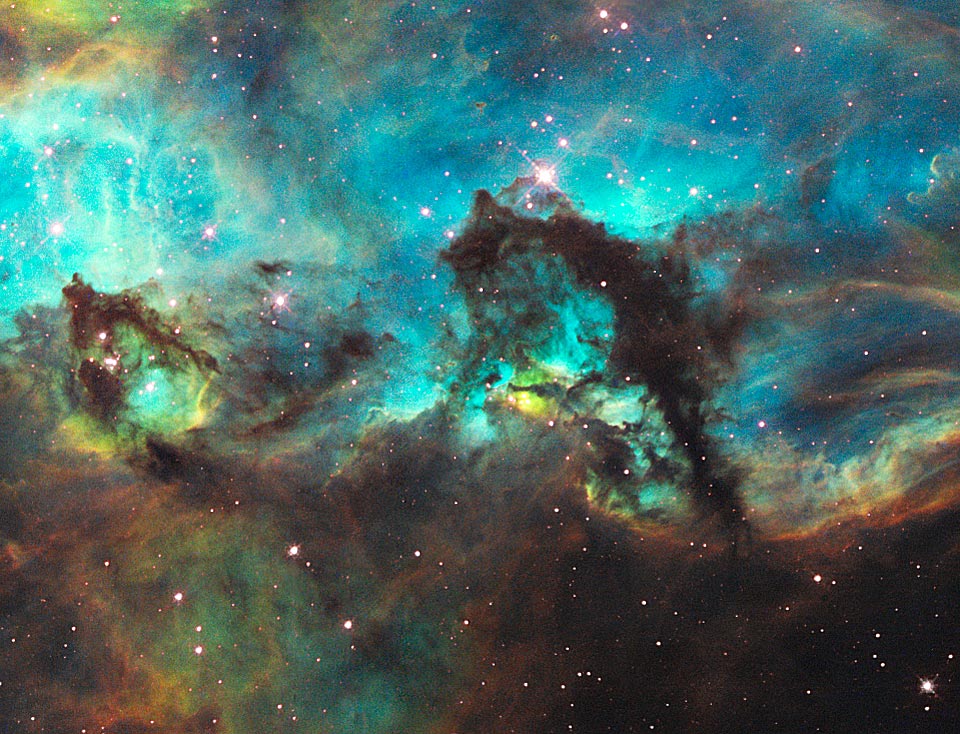
It may look like a grazing seahorse, but the dark object toward the image right is actually a pillar of smoky dust about 20 light years long. The curiously-shaped dust structure occurs in our neighboring Large Magellanic Cloud, in a star forming region very near the expansive Tarantula Nebula. The energetic nebula is creating a star cluster, NGC 2074, whose center is visible just off the top of the image in the direction of the neck of the seahorse. The representative color image was taken in 2008 by the Hubble Space Telescope's Wide Field Planetary Camera 2 in honor of Hubble's 100,000th trip around the Earth. As young stars in the cluster form, their light and winds will slowly erode the dust pillars away over the next million years. Now Available: APOD 2015 Wall Calendars