Tarantula Nebula
The Tarantula Nebula (also known as NGC 2070 or 30 Doradus) is the largest and most active star-forming region in the Local Group, located in the Large Magellanic Cloud about 160,000–170,000 light‑years away. Spanning roughly 600 light‑years, it hosts massive young star clusters like R136, contains some of the most massive stars known (up to ~200 M☉), and is shaped by intense radiation, stellar winds, and supernovae.
Source: science.nasa.gov
APODs including "Tarantula Nebula"
N159 in the Large Magellanic Cloud
28/01/2017
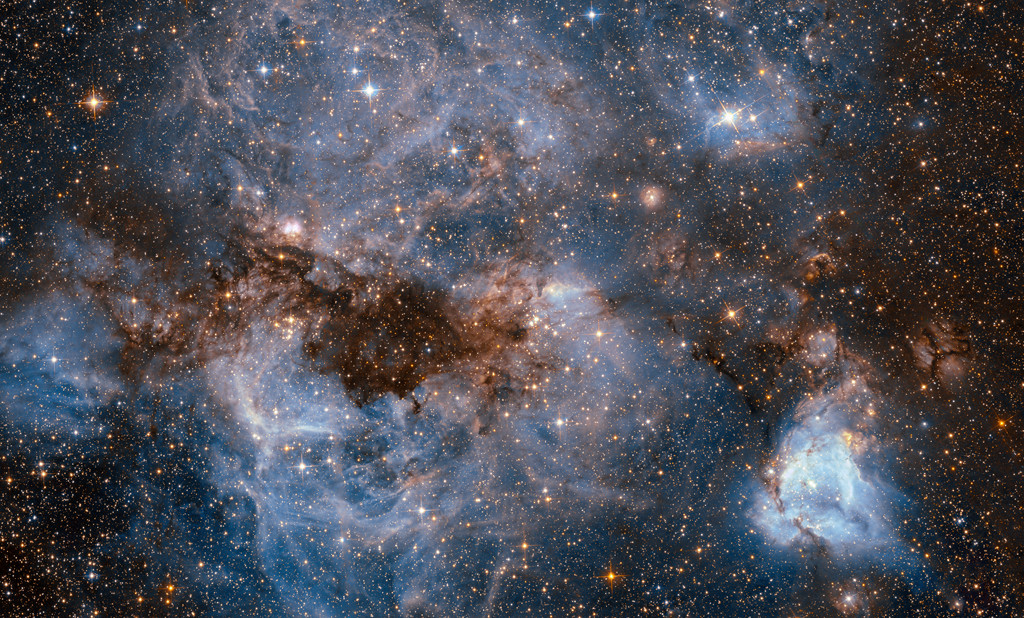
Over 150 light-years across, this cosmic maelstrom of gas and dust is not too far away. It lies south of the Tarantula Nebula in our satellite galaxy the Large Magellanic Cloud a mere 180,000 light-years distant. Massive stars have formed within. Their energetic radiation and powerful stellar winds sculpt the gas and dust and power the glow of this HII region, entered into the Henize catalog of emission stars and nebulae in the Magellanic Clouds as N159. The bright, compact, butterfly-shaped nebula above and left of center likely contains massive stars in a very early stage of formation. Resolved for the first time in Hubble images, the compact blob of ionized gas has come to be known as the Papillon Nebula. Participate: Take an Aesthetics & Astronomy Survey