Tarantula Nebula
The Tarantula Nebula (also known as NGC 2070 or 30 Doradus) is the largest and most active star-forming region in the Local Group, located in the Large Magellanic Cloud about 160,000–170,000 light‑years away. Spanning roughly 600 light‑years, it hosts massive young star clusters like R136, contains some of the most massive stars known (up to ~200 M☉), and is shaped by intense radiation, stellar winds, and supernovae.
Source: science.nasa.gov
APODs including "Tarantula Nebula"
In the Heart of the Tarantula Nebula
20/05/2018
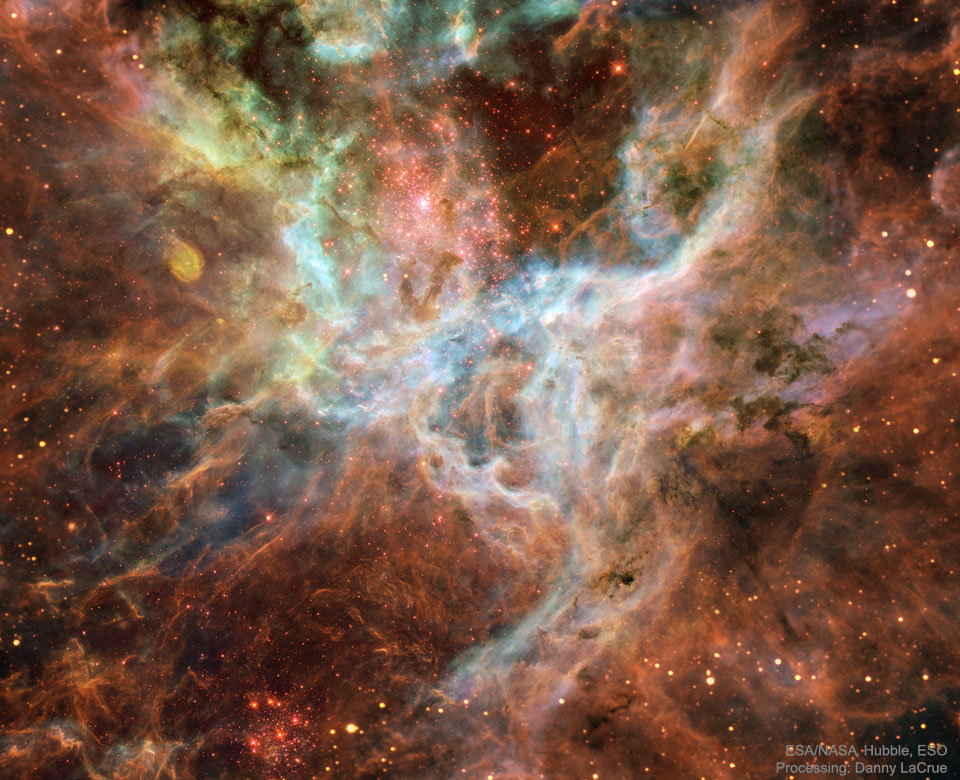
In the heart of monstrous Tarantula Nebula lies huge bubbles of energetic gas, long filaments of dark dust, and unusually massive stars. In the center of this heart, is a knot of stars so dense that it was once thought to be a single star. This star cluster, labeled as R136 or NGC 2070, is visible just above the center of the featured image and home to a great number of hot young stars. The energetic light from these stars continually ionizes nebula gas, while their energetic particle wind blows bubbles and defines intricate filaments. The representative-color picture, a digital synthesis of images from the NASA/ESA orbiting Hubble Space Telescope and ESO's ground-based New Technology Telescope, shows great details of the LMC nebula's tumultuous center. The Tarantula Nebula, also known as the 30 Doradus nebula, is one of the largest star-formation regions known, and has been creating unusually strong episodes of star formation every few million years.