The Moon
The Moon is Earth’s only natural satellite—a rocky, cratered body about one‑quarter the diameter of Earth, orbiting at an average distance of approximately 384,400 km. It influences tides, stabilizes Earth’s axial tilt, and was formed about 4.5 billion years ago following a collision between Earth and a Mars-sized object.
Source: science.nasa.gov
APODs including "The Moon"
Earth from Apollo 17
22/06/1995
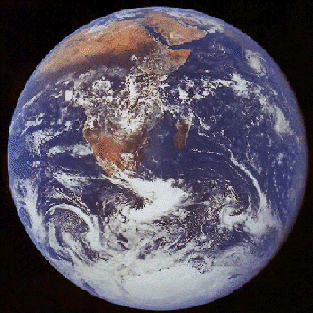
In 1972 Astronauts on the United States's last lunar mission, Apollo 17, took this picture looking back at the Earth on their way to the moon. The continents of Antarctica and Africa are visible below the delicate wisps of white clouds. For more information see NASA NSSDC press release. We keep an archive of previous Astronomy Pictures of the Day. The sky is filled with breathtaking pictures, many of which are available on the World Wide Web. Each day we feature a different picture of some part of our fascinating universe, along with a brief explanation written by a professional astronomer. Astronomy Picture of the Day is brought to you by Robert Nemiroff and Jerry Bonnell . Original material on this page is copyrighted to Robert J. Nemiroff and Jerry T. Bonnell.