The Moon
The Moon is Earth’s only natural satellite—a rocky, cratered body about one‑quarter the diameter of Earth, orbiting at an average distance of approximately 384,400 km. It influences tides, stabilizes Earth’s axial tilt, and was formed about 4.5 billion years ago following a collision between Earth and a Mars-sized object.
Source: science.nasa.gov
APODs including "The Moon"
The Earth-Moon System
29/06/1995
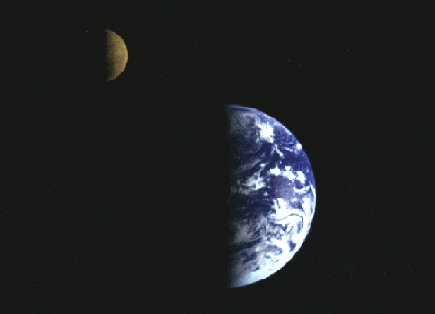
June 29, 1995 The Earth-Moon System Picture Credit: NASA, JPL, Galileo Project Explanation: A double planet? From 4 million miles away on December 16, 1992, NASA's robot spacecraft Galileo took this picture of the Earth-moon system. The bright, sunlit half of the Earth contrasts strongly with the darker subdued colors of the moon. Our moon is one of the largest moons in the solar system. It is even larger than the planet Pluto. In this picture, the Earth-moon system actually appears to be a double planet. For more information see NASA, Jet Propulsion Laboratory press release. We keep an archive of Astronomy Pictures of the Day. Astronomy Picture of the Day is brought to you by Robert Nemiroff and Jerry Bonnell . Original material on this page is copyrighted to Robert J. Nemiroff and Jerry T. Bonnell.