The Moon
The Moon is Earth’s only natural satellite—a rocky, cratered body about one‑quarter the diameter of Earth, orbiting at an average distance of approximately 384,400 km. It influences tides, stabilizes Earth’s axial tilt, and was formed about 4.5 billion years ago following a collision between Earth and a Mars-sized object.
Source: science.nasa.gov
APODs including "The Moon"
Closeup of an Io Volcano
04/08/1995
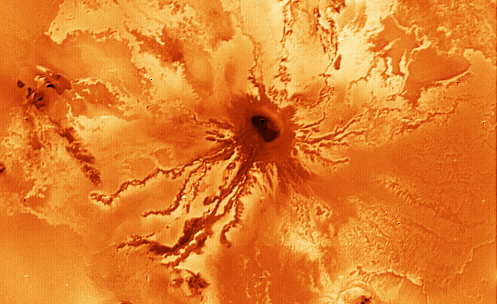
August 4, 1995 Closeup of an Io Volcano Credit: NASA, Voyager Project, Copyright Calvin J. Hamilton Explanation: In 1979, one of NASA's Voyager spacecraft made a spectacular and unexpected discovery. Io, the innermost Galilean moon of Jupiter, was covered with volcanoes and some of them were erupting! In all, Voyager 1 observed nine volcanic eruptions during its encounter with the moon. When Voyager 2 flew past four months later it was able to confirm that at least six of them were still erupting. This Voyager image of Ra Patera, a large shield volcano, shows colorful flows up to about 200 miles long emanating from the dark central volcanic vent. For more information about volcanism on Io, see Calvin J. Hamilton's Io page