The Moon
The Moon is Earth’s only natural satellite—a rocky, cratered body about one‑quarter the diameter of Earth, orbiting at an average distance of approximately 384,400 km. It influences tides, stabilizes Earth’s axial tilt, and was formed about 4.5 billion years ago following a collision between Earth and a Mars-sized object.
Source: science.nasa.gov
APODs including "The Moon"
Venus: Earth's Sister Planet
15/08/1995
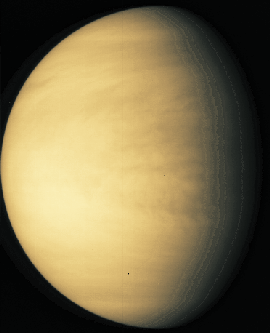
August 15, 1995 Venus: Earth's Sister Planet Credit: NASA, Galileo, Copyright Calvin J. Hamilton Explanation: This picture in visible light was taken by the Galileo spacecraft. Venus is very similar to Earth in size and mass - and so is sometimes referred to as Earth's sister planet - but Venus has a quite different climate. Venus' thick clouds and closeness to the Sun (only Mercury is closer) make it the hottest planet - much hotter than the Earth. Humans could not survive there, and no life of any sort has ever been found. When Venus is visible it is usually the brightest object in the sky after the Sun and the Moon. More than 20 spacecraft have visited Venus including Venera 9, which landed on the surface, and Magellan, which used radar to peer through the clouds and make a map of the surface. There are still many things about Venus's unusual atmosphere that astronomers don't understand.