The Moon
The Moon is Earth’s only natural satellite—a rocky, cratered body about one‑quarter the diameter of Earth, orbiting at an average distance of approximately 384,400 km. It influences tides, stabilizes Earth’s axial tilt, and was formed about 4.5 billion years ago following a collision between Earth and a Mars-sized object.
Source: science.nasa.gov
APODs including "The Moon"
Saturn V: NASA's Largest Rocket
29/08/1995
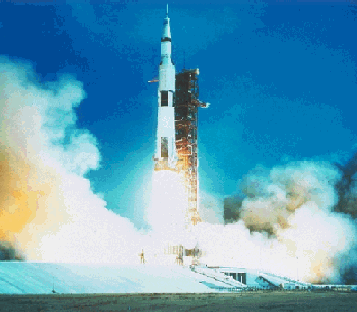
August 29, 1995 Saturn V: NASA's Largest Rocket Credit: NASA, Kennedy Space Center, Explanation: Pictured, a NASA Saturn V rocket blasts off on July 16th, 1969 carrying the crew of Apollo 11 to the Moon. The Saturn V rocket was the largest rocket ever used by NASA, and the only one able to lift the large masses needed to land astronauts on the moon and returning them safely. Saturn V rockets launched all of the Apollo moon missions, and several to Earth orbit as well.