The Moon
The Moon is Earth’s only natural satellite—a rocky, cratered body about one‑quarter the diameter of Earth, orbiting at an average distance of approximately 384,400 km. It influences tides, stabilizes Earth’s axial tilt, and was formed about 4.5 billion years ago following a collision between Earth and a Mars-sized object.
Source: science.nasa.gov
APODs including "The Moon"
The Last Moon Shot
09/09/1995
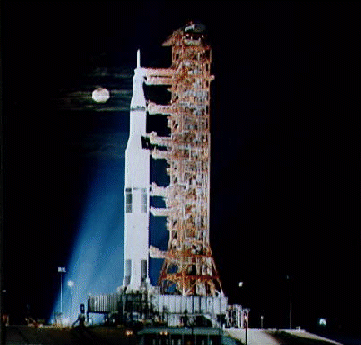
September 9, 1995 The Last Moon Shot Credit: NASA, The Apollo Program Explanation: In 1865 Jules Verne predicted the invention of a space capsule that could carry people. In his science fiction story "From the Earth to the Moon", he outlined his vision of constructing a cannon in Florida so powerful that it could shoot a "Projectile-Vehicle" carrying three adventurers to the Moon. Over 100 years later, NASA, guided by Wernher Von Braun's vision, produced the Saturn V rocket. This rocket turned Verne's fiction into fact, launching 9 Apollo Lunar missions and allowing 12 astronauts to walk on the Moon. Pictured above is the last moon shot, Apollo 17, awaiting a night launch in December of 1972. Spot lights play on the rocket and launch pad while the full Moon looms in the background. Humans have not walked on the lunar surface since. Should we return to the Moon?