The Moon
The Moon is Earth’s only natural satellite—a rocky, cratered body about one‑quarter the diameter of Earth, orbiting at an average distance of approximately 384,400 km. It influences tides, stabilizes Earth’s axial tilt, and was formed about 4.5 billion years ago following a collision between Earth and a Mars-sized object.
Source: science.nasa.gov
APODs including "The Moon"
The Far Side
14/09/1995
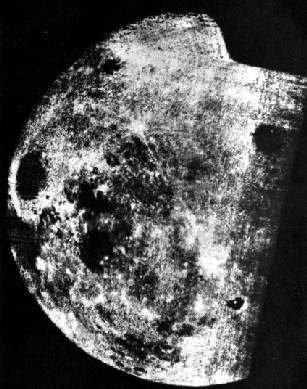
This historic picture was humanity's first glimpse of the far side of the Moon. It was taken by the Soviet spacecraft Luna 3 in October of 1959. Luna 3 followed closely on the heels of another Soviet probe, Luna 2, which had become the first spacecraft to impact the Moon on September 13th of that same year. Why does the Moon have a far side? Gravitational tidal forces within the Earth-Moon system have synchronized the Moon's period of rotation around its axis with its orbital period at about 28 days. So, as the Moon moves around its orbit its rotation exactly compensates, keeping the same face toward the Earth.