The Moon
The Moon is Earth’s only natural satellite—a rocky, cratered body about one‑quarter the diameter of Earth, orbiting at an average distance of approximately 384,400 km. It influences tides, stabilizes Earth’s axial tilt, and was formed about 4.5 billion years ago following a collision between Earth and a Mars-sized object.
Source: science.nasa.gov
APODs including "The Moon"
Apollo 14 Deploys ALSEP
10/12/1995
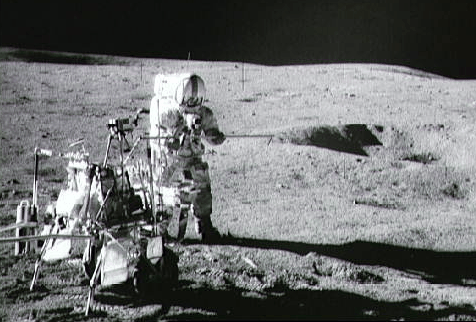
After the lunar module of Apollo 14 set down on the Moon, Astronauts Alan Shepard and Edgar Mitchell deployed the Apollo Lunar Surface Experiments Package (ALSEP) and collected samples of lunar material. The ALSEP scientific experiments included a seismometer sensitive to slight lunar surface movements, and charged particle detectors which measured the solar wind. The seismometer successfully measured surface tremors interpreted as moonquakes and meteoroids striking the Moon, while the solar wind experiment was sensitive enough to detect the element argon. These and other ALSEP experiments helped classify the internal structure and magnetic field of Earth's Moon. Shepard and Mitchell also made a geology traverse to the rim of Cone Crater, carrying their tools and sample containers in the Modular Equipment Transporter (MET). In this picture Alan Shepard assembles a core tube which he will then hammer into the surface.