The Moon
The Moon is Earth’s only natural satellite—a rocky, cratered body about one‑quarter the diameter of Earth, orbiting at an average distance of approximately 384,400 km. It influences tides, stabilizes Earth’s axial tilt, and was formed about 4.5 billion years ago following a collision between Earth and a Mars-sized object.
Source: science.nasa.gov
APODs including "The Moon"
Mercury's Caloris Basin
20/01/1996
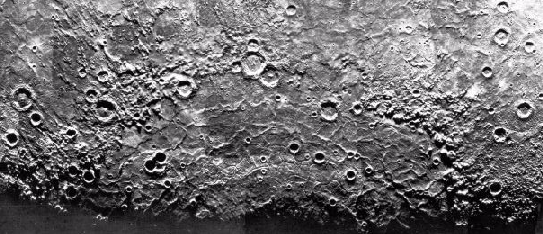
Mercury, the closest planet to the Sun, has a surface with so many craters it resembles the Earth's Moon. The largest surface feature on Mercury is the Caloris Basin, which resulted from a collision with an asteroid. The basin, which is more that 1000 kilometers across, is visible as the large circular feature at the bottom of the above photograph. Similar features, such as the Mare Orientale, are seen on the Moon. The Caloris Basin gets very hot because it is near the "sub-solar point" - the point on Mercury's surface that is directly under the Sun when Mercury is closest to the Sun.