The Moon
The Moon is Earth’s only natural satellite—a rocky, cratered body about one‑quarter the diameter of Earth, orbiting at an average distance of approximately 384,400 km. It influences tides, stabilizes Earth’s axial tilt, and was formed about 4.5 billion years ago following a collision between Earth and a Mars-sized object.
Source: science.nasa.gov
APODs including "The Moon"
X-ray Moon and X-ray Star
27/02/1996
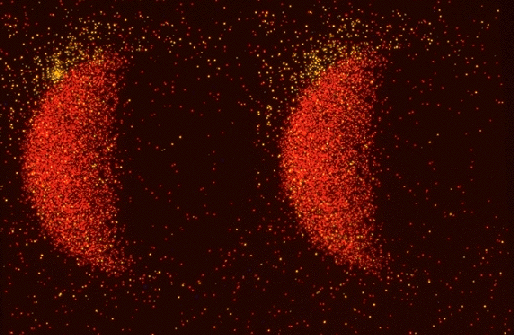
An X-ray star winks out behind the Moon in these before and after views of a lunar occultation of the galactic X-ray source designated GX5-1. The false color images were made using data from the ROSAT orbiting observatory and show high energy X-rays in yellow (mostly from GX5-1), and lower energy X-rays in red (the Moon reflecting X-rays from the Sun). GX5-1 is a binary system consisting of a neutron star and a companion star in mutual orbit about the system's center of mass. The gas in the companion star's outer envelope falls toward the neutron star and accumulates in a disk around it. This disk material swirls deeper in to the neutron star's gravitational well, and is finally dumped onto its surface - in the process creating tremendous temperatures and generating the high energy X-rays.