The Moon
The Moon is Earth’s only natural satellite—a rocky, cratered body about one‑quarter the diameter of Earth, orbiting at an average distance of approximately 384,400 km. It influences tides, stabilizes Earth’s axial tilt, and was formed about 4.5 billion years ago following a collision between Earth and a Mars-sized object.
Source: science.nasa.gov
APODs including "The Moon"
Uranus' Moon Ariel: Valley World
03/03/1996
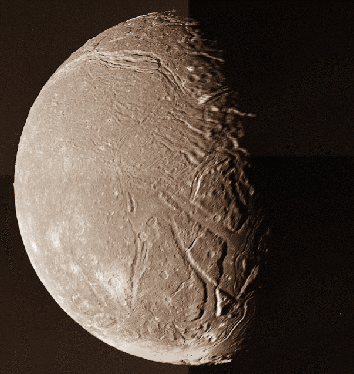
What formed Ariel's valleys? This question presented itself when Voyager 2 passed this satellite of Uranus in January 1986. Speculation includes that heating caused by the ancient tides of Uranus caused moonquakes and massive shifting of the moon's surface. In any event, a huge network of sunken valleys was found to cover this frozen moon, and some unknown material now coats the bottoms of many of these channels. Ariel is the second closest to Uranus outside of Miranda, and is composed of roughly half water ice and half rock. Ariel was discovered by William Lassell in 1851. Information: The Scale of the Universe Debate in April 1996