The Moon
The Moon is Earth’s only natural satellite—a rocky, cratered body about one‑quarter the diameter of Earth, orbiting at an average distance of approximately 384,400 km. It influences tides, stabilizes Earth’s axial tilt, and was formed about 4.5 billion years ago following a collision between Earth and a Mars-sized object.
Source: science.nasa.gov
APODs including "The Moon"
The Iron Moon
01/06/1996
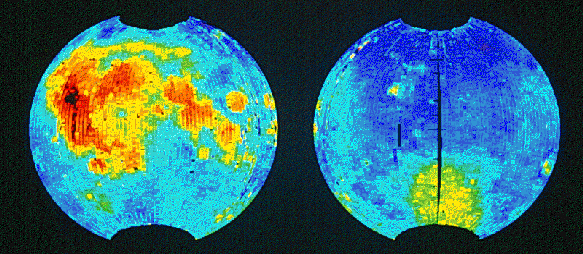
In March and April of 1994 the unmanned Clementine spacecraft demonstrated the technique of prospecting on the Moon from lunar orbit. To accomplish this, Clementine turned an array of cameras sensitive to ultraviolet-visible and near-infrared light toward the lunar surface, producing the first broad-spectrum global imaging of the moon. Using this data, scientists were able to create the above map showing the concentration of iron in the lunar soils. The striking difference between the near (left) and farside (right) hemisphere's offers clues about the Moon's early history.