The Moon
The Moon is Earth’s only natural satellite—a rocky, cratered body about one‑quarter the diameter of Earth, orbiting at an average distance of approximately 384,400 km. It influences tides, stabilizes Earth’s axial tilt, and was formed about 4.5 billion years ago following a collision between Earth and a Mars-sized object.
Source: science.nasa.gov
APODs including "The Moon"
A Violet Moon
31/07/1996
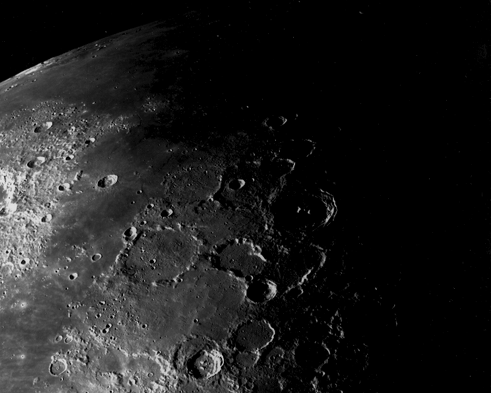
Checking out the Galileo spacecraft's cameras during its December 1992 flyby of Earth's Moon, controllers took this dramatically illuminated picture through a violet filter. The view looks down on the Moon's north polar region with the Sun shining from the left at a low angle and the direction toward the moon's North pole toward the lower right. Across the image upper left stretches the smooth volcanic plain of the Mare Imbrium. Pythagoras crater, 65 miles wide, is near the center of the image -- mostly in shadow, its central peak just catches the sunlight. Yesterday, the Moon made its closest approach to Earth and was full for the second time in July (as reckoned by UT dates). The closest point in the Moon's orbit is referred to as Lunar Perigee, a mere 221,797 miles at 8 hours UT. The second full moon in a month is known as a "Blue Moon".