The Moon
The Moon is Earth’s only natural satellite—a rocky, cratered body about one‑quarter the diameter of Earth, orbiting at an average distance of approximately 384,400 km. It influences tides, stabilizes Earth’s axial tilt, and was formed about 4.5 billion years ago following a collision between Earth and a Mars-sized object.
Source: science.nasa.gov
APODs including "The Moon"
Galileo Views Io Eruption
15/08/1996
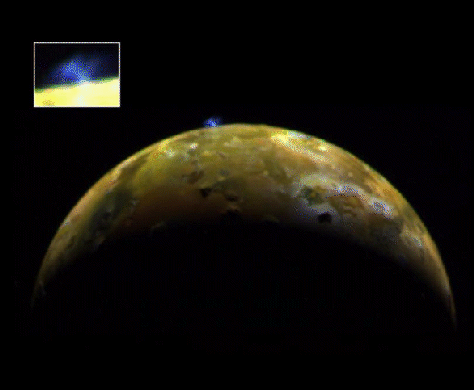
Io's surface is active. Geyser-like eruptions from volcanoes on this Jovian moon were seen by both Voyager spacecraft in 1979 and were also spotted this year in late June by Galileo's camera from a distance of about 600,000 miles. The blue plume seen at the moon's edge (magnified in the inset) arises from Ra Patera, a large shield volcano, and extends about 60 miles above the surface. The blue color is attributed to condensing and freezing sulfur dioxide gas. Galileo images have also revealed that the plume glows in the dark - perhaps due to fluorescence of excited sulfur and oxygen ions. Io's surface is cold, its temperature averages about -230 degrees Fahrenheit, so why is it so active? The most likely cause is the gravitational tug of war over Io between Jupiter and the other Galilean moons which perturbs Io's orbit. The orbital changes would result in tidal force variations heating Io's interior and and generating the sulfurous volcanic activity.