The Moon
The Moon is Earth’s only natural satellite—a rocky, cratered body about one‑quarter the diameter of Earth, orbiting at an average distance of approximately 384,400 km. It influences tides, stabilizes Earth’s axial tilt, and was formed about 4.5 billion years ago following a collision between Earth and a Mars-sized object.
Source: science.nasa.gov
APODs including "The Moon"
The Moon and All the Crashes
19/09/1996
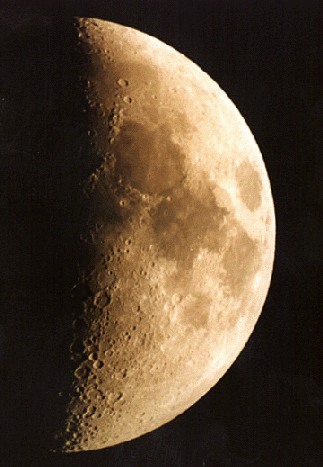
A clear blue summer sky finally grows dark and the new telescope, hastily set up in the backyard, generates excitment and anticipation. "I bought it for the kids ...", Dad assures himself as he over-anxiously supervises the two young boys' efforts to center a bright, first quarter Moon, in the finder. The evening's first target acquired, James adjusts the focus knob and falls silent. Suddenly, "Wow, looks just like on Apollo 13!". His younger brother Christopher takes his turn. "Do you see the Moon?", James asks, eager to provide guidance based on his own observing experience. Christopher echoes his brother's enthusiasm, "Yes, and I see all the crashes too!". The view they shared was not too different from the above image of a six day old moon, recorded in July 1995 by Rhode Island amateur astronomer Jim Hendrickson. Along the terminator, the line between lunar night and day, the shadows outline to advantage the spectacular craters -- caused by all the crashes. Information: Thursday, September 26 - A Total Lunar Eclipse