The Moon
The Moon is Earth’s only natural satellite—a rocky, cratered body about one‑quarter the diameter of Earth, orbiting at an average distance of approximately 384,400 km. It influences tides, stabilizes Earth’s axial tilt, and was formed about 4.5 billion years ago following a collision between Earth and a Mars-sized object.
Source: science.nasa.gov
APODs including "The Moon"
The X-Ray Moon Credit:
29/09/1996
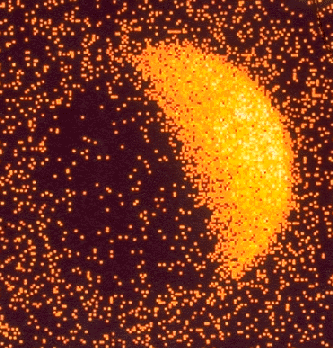
This X-Ray image of the Moon was made by the orbiting Roentgen Observatory Satellite (ROSAT) in 1990. It shows three distinct regions: a bright X-ray sky, a bright part of the Moon, and a relatively dark part of the Moon. The bright X-ray sky is due to the diffuse cosmic X-ray background. The bright lunar crescent shines because it reflects X-rays emitted by the Sun. The dark lunar face is in shadow and so stands stands out from the relatively bright background - but, surprisingly it is not completely dark! Where do those X-rays from? They are currently thought to result from energetic particles from the solar wind bombarding the lunar surface.