The Moon
The Moon is Earth’s only natural satellite—a rocky, cratered body about one‑quarter the diameter of Earth, orbiting at an average distance of approximately 384,400 km. It influences tides, stabilizes Earth’s axial tilt, and was formed about 4.5 billion years ago following a collision between Earth and a Mars-sized object.
Source: science.nasa.gov
APODs including "The Moon"
Eclipsed Moon in Infrared
10/01/1997
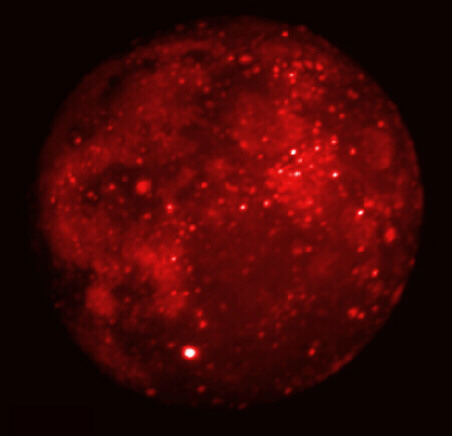
Last September's total lunar eclipse disappointed many observers in the Eastern and Midwestern US who were cursed with cloudy skies. However, the Midcourse Space Experiment (MSX) satellite had a spectacular view from Earth orbit and SPIRIT III, an onboard imaging infrared telescope, was used to repeatedly image the moon during the eclipse. Above is one of the images taken during the 70 minute totality, the Moon completely immersed in the Earth's shadow. Infrared light has wavelengths longer than visible light - human's can not see it but feel it as heat. The bright spots correspond to the warm areas on the lunar surface, dark areas are cooler. The brightest spot below and left of center is the crater Tycho, the dark region at the upper right is the Mare Crisium. The series of SPIRIT III images allow the determination of cooling curves for geologically different areas, exploring the physical properties of the Moon's surface.