The Moon
The Moon is Earth’s only natural satellite—a rocky, cratered body about one‑quarter the diameter of Earth, orbiting at an average distance of approximately 384,400 km. It influences tides, stabilizes Earth’s axial tilt, and was formed about 4.5 billion years ago following a collision between Earth and a Mars-sized object.
Source: science.nasa.gov
APODs including "The Moon"
Europa: The Latest From Galileo
17/01/1997
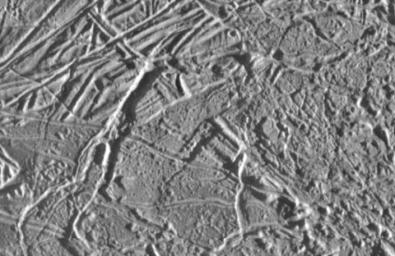
Today, NASA revealed recent results from the Galileo Probe's December 19th flyby of Europa, Jupiter's ice-covered moon - including this close-up image of fractured and frozen terrrain. The highest resolution picture ever made of Europa, the snapshot shows a complex array of surface features in a 5.9 x 9.9 mile area near the moon's equatorial region. North is toward the top and the Sun illuminates the region from the right. The image was made from a distance of 2,060 miles. At the upper left are linear criss-crossing ridges and grooves probably caused by movements of the surface ice. Serpentine valleys and lumpy features of unknown origins are also visible. Only a few impact craters are apparent though, implying a geologically young surface. So far, Galileo's findings lend support to the exciting possibility that liquid water once existed and may still exist beneath Europa's surface.