The Moon
The Moon is Earth’s only natural satellite—a rocky, cratered body about one‑quarter the diameter of Earth, orbiting at an average distance of approximately 384,400 km. It influences tides, stabilizes Earth’s axial tilt, and was formed about 4.5 billion years ago following a collision between Earth and a Mars-sized object.
Source: science.nasa.gov
APODs including "The Moon"
Mercury Astronauts and a Redstone Credit:
06/04/1997
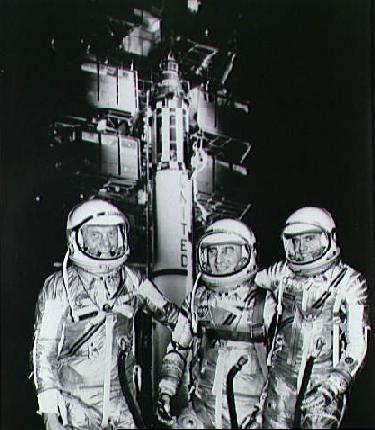
Space suited project Mercury astronauts John H. Glenn, Virgil I. Grissom, and Alan B. Shepard Jr. (left to right) are pictured here posing in front of a Redstone rocket in this vintage 1961 NASA publicity photo. Project Mercury was the first U.S. program designed to put humans in space. It resulted in 6 flights using one-man capsules and Redstone and Atlas rockets. Shortly after the first U.S. manned flight on May 5, 1961, a suborbital flight piloted by Alan Shepard, President Kennedy announced the goal of a manned lunar landing by 1970. This goal was achieved by NASA's Apollo program and Shepard himself walked on the moon as commander of the Apollo 14 mission.