The Moon
The Moon is Earth’s only natural satellite—a rocky, cratered body about one‑quarter the diameter of Earth, orbiting at an average distance of approximately 384,400 km. It influences tides, stabilizes Earth’s axial tilt, and was formed about 4.5 billion years ago following a collision between Earth and a Mars-sized object.
Source: science.nasa.gov
APODs including "The Moon"
Oceans Under Jupiter's Europa? Credit:
09/04/1997
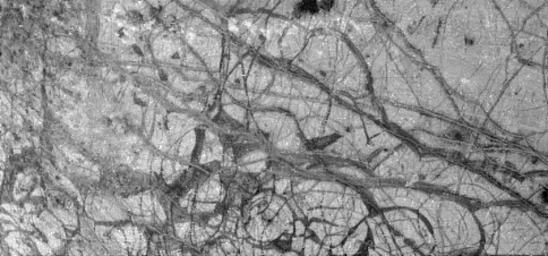
Is there life beneath Europa? Today, new results are being announced (at about 2 pm EST) about the possibility of oceans under Jupiter's moon Europa. The existence of such oceans increases the likelihood that some sort of life exists beneath the fractured ice planes of Jupiter's smoothest satellite. Results from the February 20th flyby of the robot spacecraft Galileo past Europa now clearly indicate that either large bodies of water or slush exist under a relatively thin ice sheet covering the moon's surface, at least in some regions. Areas on the surface are marked by very few craters, indicating that water flowed there in the time since most craters formed.