The Moon
The Moon is Earth’s only natural satellite—a rocky, cratered body about one‑quarter the diameter of Earth, orbiting at an average distance of approximately 384,400 km. It influences tides, stabilizes Earth’s axial tilt, and was formed about 4.5 billion years ago following a collision between Earth and a Mars-sized object.
Source: science.nasa.gov
APODs including "The Moon"
Io's Sodium Cloud Credit:
28/04/1997
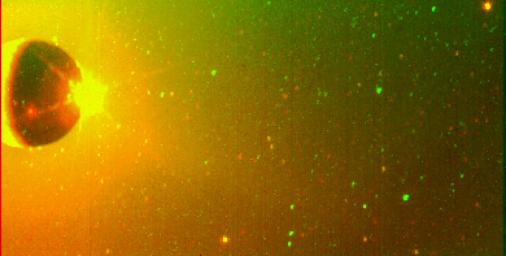
Io has its own cloud. Jupiter's most active moon is visible on the left of the above false-color photograph, with its left side illuminated by sunlight. But what is happening on Io's right side? Here a plume of gas from the active volcano Prometheus also reflects sunlight. A second active volcano, Pele, is also visible: marked by the red spot just below Io's center. Surrounding the moon is a yellow haze originating from gas ejected by Io's volcanos. Sodium atoms in the gas cloud are particulary efficient at reflecting yellow light. Several points of light are background stars.