The Moon
The Moon is Earth’s only natural satellite—a rocky, cratered body about one‑quarter the diameter of Earth, orbiting at an average distance of approximately 384,400 km. It influences tides, stabilizes Earth’s axial tilt, and was formed about 4.5 billion years ago following a collision between Earth and a Mars-sized object.
Source: science.nasa.gov
APODs including "The Moon"
Apollo 15: Driving on the Moon
07/06/1997
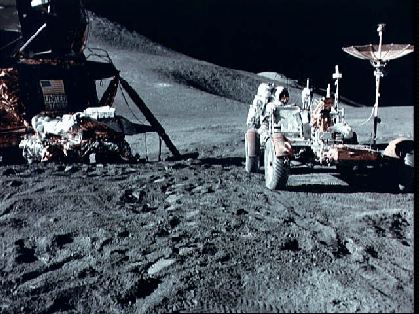
Apollo 15 astronaut James Irwin works on the first Lunar Roving Vehicle, before he and fellow astronaut David Scott take it out for a drive. Sloping up behind the lunar module "Falcon" on the left are lunar mountains Hadley Delta and Apennine Front, while about 5 kilometers behind Irwin is St. George Crater. The explorations conducted during the Apollo lunar missions discovered much about our Moon, including that the Moon is made of ancient rock, that the Moon's composition is similar to Earth's, that life is not evident there, that the Moon underwent a great hot melting in its distant past, that the Moon has suffered from numerous impacts as shown by its craters, and that the Moon's surface is covered by a layer of rock fragments and dust.