The Moon
The Moon is Earth’s only natural satellite—a rocky, cratered body about one‑quarter the diameter of Earth, orbiting at an average distance of approximately 384,400 km. It influences tides, stabilizes Earth’s axial tilt, and was formed about 4.5 billion years ago following a collision between Earth and a Mars-sized object.
Source: science.nasa.gov
APODs including "The Moon"
Help Aldebaran Map the Moon
28/07/1997
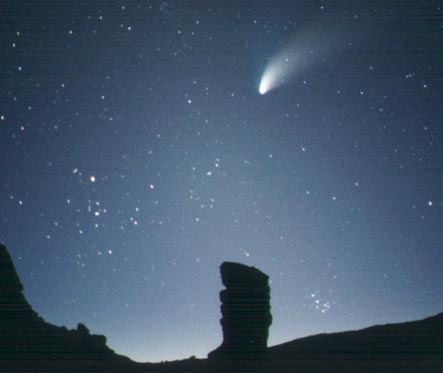
Turn on your camcorder, go outside, and become an astronomer. How?. Tomorrow morning, our Moon will pass directly in front of Aldebaran, the brightest star in this picture and in entire constellation of Taurus. Aldebaran is visible to the left and below Comet Hale-Bopp in the above photograph, which was taken on April 30th in Tenerife, Spain. This occultation is valuable because disappearance times from different locations can be used to map the height of the lunar terrain at the occultation points. You can help by clicking here, where a site will detail how to tape a familiar cable channel and then take your still-running camcorder outside to tape the occultation of Aldebaran by the Moon. You can then donate your VCR tape to science by mailing it to this address. Leave yourself plenty of time for a practice run and be sure to check the weather before going to a lot of trouble!