The Moon
The Moon is Earth’s only natural satellite—a rocky, cratered body about one‑quarter the diameter of Earth, orbiting at an average distance of approximately 384,400 km. It influences tides, stabilizes Earth’s axial tilt, and was formed about 4.5 billion years ago following a collision between Earth and a Mars-sized object.
Source: science.nasa.gov
APODs including "The Moon"
The Leonid Meteor Shower
16/11/1997
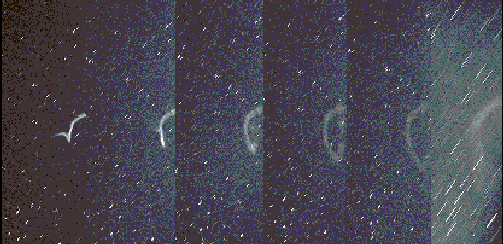
The Leonid Meteor Shower will likely reach its peak in the early hours this Monday morning. Though the Moon will be bright, Leo, the shower's radiant point, will be well above the eastern horizon from Western North America and the Pacific region during this period. This year's Leonids may prove particularly exciting as observers anticipate the legendary Leonid storm of activity will occur sometime during the next few apparitions of this annual meteor shower - although most expect the meteor storm to occur in 1998 or 1999. Meteor showers result from debris left by passing comets. The Leonids specifically are small pieces of Comet Tempel-Tuttle. In the above series of time-lapse, 1-minute exposures, a 1995 Leonid is seen to leave a train of hot air that glowed persistently for several minutes.