The Moon
The Moon is Earth’s only natural satellite—a rocky, cratered body about one‑quarter the diameter of Earth, orbiting at an average distance of approximately 384,400 km. It influences tides, stabilizes Earth’s axial tilt, and was formed about 4.5 billion years ago following a collision between Earth and a Mars-sized object.
Source: science.nasa.gov
APODs including "The Moon"
Jupiter: Moon, Ring, and Clouds
21/11/1997
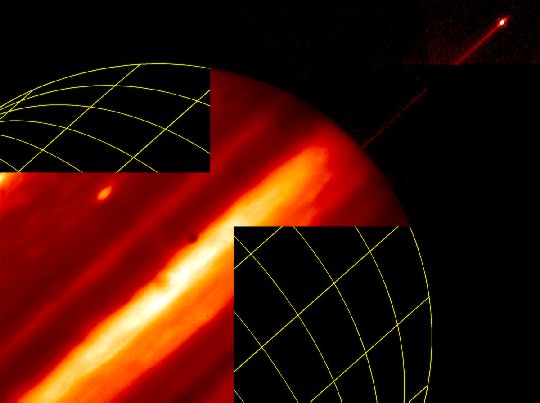
An inner moon, an edge-on, planet-girdling ring, and high altitude cloud bands are visible in this mosaic of infrared images of gas giant Jupiter. The moon Metis, 25 miles wide and about 80,000 miles from the planet, is the bright spot at the upper right. Metis lies within Jupiter's faint, tenuous ring, and may be a source of ring material. Recorded on September 17th by the NICMOS instrument on board the Hubble Space Telescope, these pictures also emphasize atmospheric features high above the main jovian cloud deck. Methane gas in Jupiter's atmosphere absorbs the near infrared light causing deeper clouds to appear dark at these wavelengths. Clouds riding above most of the atmospheric methane are bright. The circular dark spot just above the brightest cloud band is an image artifact.