The Moon
The Moon is Earth’s only natural satellite—a rocky, cratered body about one‑quarter the diameter of Earth, orbiting at an average distance of approximately 384,400 km. It influences tides, stabilizes Earth’s axial tilt, and was formed about 4.5 billion years ago following a collision between Earth and a Mars-sized object.
Source: science.nasa.gov
APODs including "The Moon"
The Comet and the Galaxy
25/11/1997
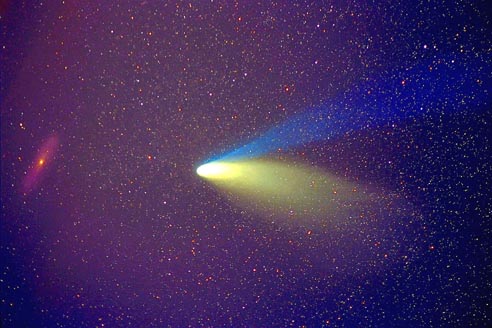
The Moon almost ruined this photograph. During late March and early April, Comet Hale-Bopp passed nearly in front of the Andromeda Galaxy. Here the Great Comet of 1997 and the Great Galaxy in Andromeda were photographed together on March 24th. The problem was the brightness of the Moon. The Moon was full that night and so bright that long exposures meant to capture the tails of Hale-Bopp and the disk of M31 would capture instead only moonlight reflected off the Earth's atmosphere. By the time the Moon would set, this opportunity would be gone. That's why this picture was taken during the lunar eclipse.