The Moon
The Moon is Earth’s only natural satellite—a rocky, cratered body about one‑quarter the diameter of Earth, orbiting at an average distance of approximately 384,400 km. It influences tides, stabilizes Earth’s axial tilt, and was formed about 4.5 billion years ago following a collision between Earth and a Mars-sized object.
Source: science.nasa.gov
APODs including "The Moon"
Jupiter's Inner Moons
27/11/1997
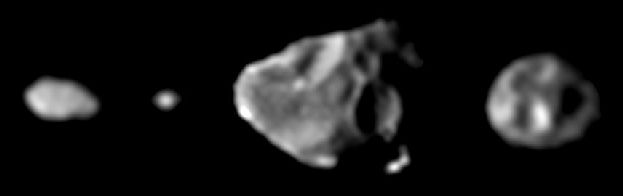
The potato-shaped inner moons of Jupiter are lined-up in this mosaic "family portrait" of these tiny Jovian satellites. The individual images were recorded over the last year by NASA's Galileo spacecraft and are scaled to the moons' relative sizes. Left to right in increasing order of distance from Jupiter are Metis (longest dimension 37 miles), Adrastea (12 miles), Amalthea (154 miles), and Thebe (72 miles). All these moons orbit in the zone between Io and Jupiter's rings, are bombarded by high-energy ions within the Jovian magnetosphere, and are probably locked in synchronous rotation by Jupiter's strong gravity. Why are they shaped like potatoes? Like the asteroids and the diminutive moons of Mars, their own gravity is not strong enough to mold them into spheres.