The Moon
The Moon is Earth’s only natural satellite—a rocky, cratered body about one‑quarter the diameter of Earth, orbiting at an average distance of approximately 384,400 km. It influences tides, stabilizes Earth’s axial tilt, and was formed about 4.5 billion years ago following a collision between Earth and a Mars-sized object.
Source: science.nasa.gov
APODs including "The Moon"
The Barren Moon
03/01/1998
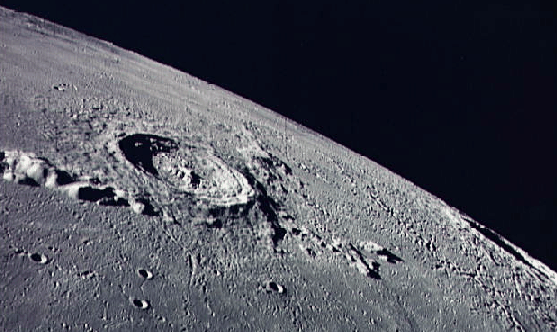
The above photo, taken as the Apollo 17 astronauts orbited the Moon in 1972, depicts the stark lunar surface around the Eratosthenes and Copernicus craters. Many similar images of a Moon devoid of life are familiar to denizens of the space age. Contrary to this modern perception, life on the Moon was reported in August of 1835 in a series of sensational stories first published by the New York Sun - apparently intended to improve the paper's circulation. These descriptions of lunar life received broad credence and became one of the most spectacular hoaxes in history. Supposedly based on telescopic observations, the stories featured full, lavish accounts of a Moon with oceans and beaches, teeming with plant and animal life and climaxing with the report of sightings of groups of winged, furry, human-like creatures resembling bats! Within a month the hoax had been revealed but the newspaper continued to enjoy an increased readership. Though barren, the Moon remains a popular setting for science fiction stories and extra-terrestrial adventures. It has now been 25 years since Apollo 17 ended an era of human exploration of Earth's Moon.