The Moon
The Moon is Earth’s only natural satellite—a rocky, cratered body about one‑quarter the diameter of Earth, orbiting at an average distance of approximately 384,400 km. It influences tides, stabilizes Earth’s axial tilt, and was formed about 4.5 billion years ago following a collision between Earth and a Mars-sized object.
Source: science.nasa.gov
APODs including "The Moon"
Solar Eclipse: A Composite View
27/02/1998
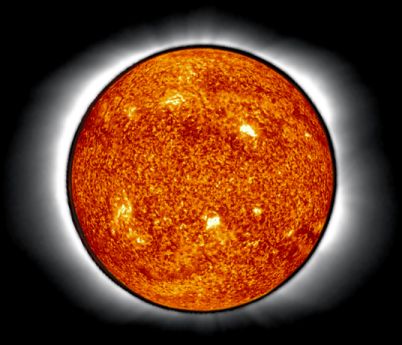
Yesterday, the Moon's shadow reached out and touched the Earth, treating a large portion of the Western Hemisphere to an Eclipse of the Sun. This composite image combines pictures of the Sun made from both Earth and space. The central direct image of the solar surface was recorded yesterday by the Extreme Ultraviolet Imaging Telescope on board the space based SOHO observatory. It is surrounded by a telescopic picture of the Sun as seen from the island of Aruba during the total eclipse. The surrounding view of the eclipsed Sun reveals the gleaming solar corona, visible to ground based observers during totality. Such combined images can help connect explosive events and features on the Sun's surface with the corona and solar wind.