The Moon
The Moon is Earth’s only natural satellite—a rocky, cratered body about one‑quarter the diameter of Earth, orbiting at an average distance of approximately 384,400 km. It influences tides, stabilizes Earth’s axial tilt, and was formed about 4.5 billion years ago following a collision between Earth and a Mars-sized object.
Source: science.nasa.gov
APODs including "The Moon"
The Moons Of Earth
13/08/1998
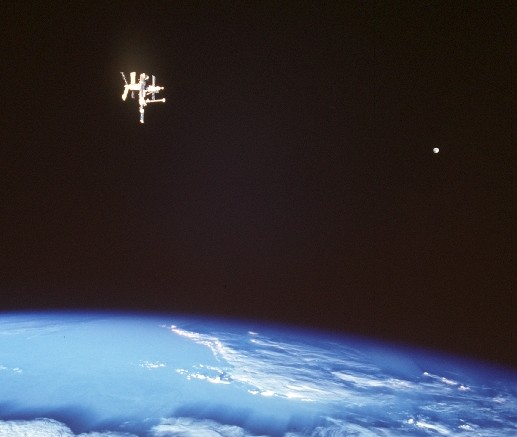
While orbiting the planet during their June 1998 mission, the crew of the Space Shuttle Discovery photographed this view of two moons of Earth. Thick storm clouds are visible in the lovely blue planet's nurturing atmosphere and its largest artificial moon, the spindly Russian Mir Space Station, can be seen above the planet's limb. The bright spot to the right of Mir is Earth's very large natural satellite, The Moon. The Mir orbits planet Earth once every 90 minutes about 200 miles above the planet's surface or about 4,000 miles from Earth's center. The Moon orbits once every 28 days at a distance of about 250,000 miles from the center of the Earth.